
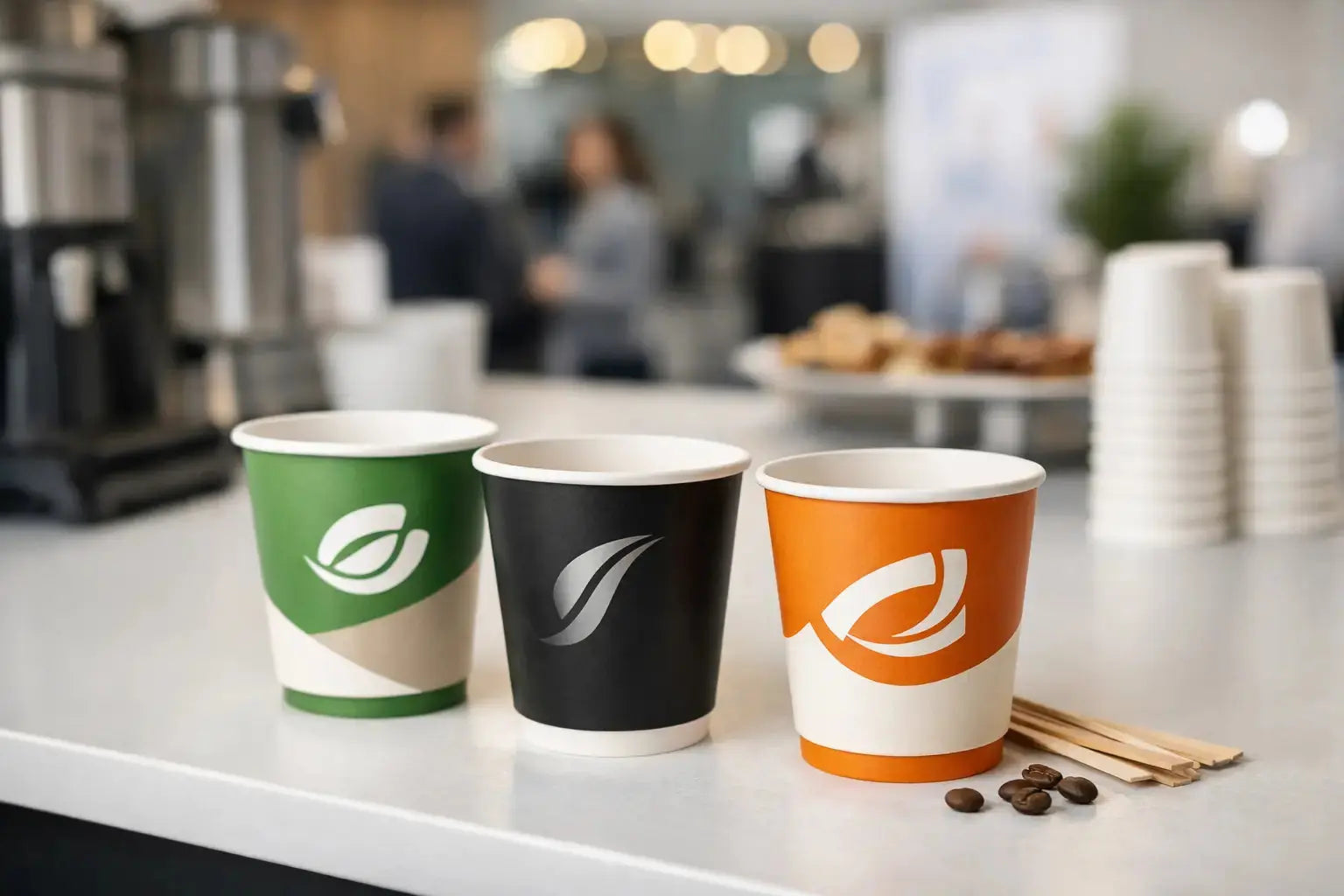
A coffee counter can serve hundreds of people before anyone notices the menu board. A well-designed cup, however, stays in each customer’s hand through the meeting, queue, commute, or event floor. This guide to branded paper cups explains how to choose a practical cup specification that supports service, protects drink quality, and keeps your brand consistent at every touchpoint.
For restaurants, cafés, offices, retail launches, exhibitions, and corporate events, a branded cup is not simply packaging. It is a repeat-use brand surface with operational requirements. The right choice depends on what you are serving, how it is handed over, where it will be used, and how clearly your artwork needs to reproduce.
Start with the serving situation
Cup selection should begin with the beverage and the service model, not the logo. A café serving hot coffee throughout the day has different needs from an event team distributing chilled drinks over a few hours. Procurement teams should also consider whether lids, sleeves, stirrers, napkins, and takeaway bags need to work together as one branded packaging system.
For hot drinks, the main concern is heat insulation and comfortable handling. Single-wall paper cups are a straightforward option for lower-temperature beverages or situations where a separate sleeve will be used. They can be efficient for high-volume service and give you flexibility to add a sleeve with campaign-specific messaging.
Double-wall cups include an additional paper layer that improves insulation and creates a more substantial feel in hand. They are often the better fit for hot coffee, tea, and other drinks that guests may carry around an office, venue, or exhibition. The trade-off is higher material use and a different print surface, so it is worth confirming the intended design and budget before placing an order.
For cold beverages, condensation and lid compatibility matter. Choose a cup construction suited to the drink temperature, filling method, and expected holding time. If beverages will be prepared in advance, ask your supplier to recommend a material and lid combination based on actual use rather than selecting by cup size alone.
Choose a size that matches the menu
A branded cup should feel proportionate to the drink it carries. An oversized cup can make a standard serving look underfilled, while a smaller cup may create spills, limit lid fit, or slow service. Standard paper cup sizes commonly cover short coffee servings, regular tea and coffee, large hot drinks, and event-friendly cold beverages.
Before requesting a quote, map each cup size to a specific menu item. For example, a smaller cup may suit espresso-based servings, while a medium size supports regular coffee and tea orders. Larger formats work well for iced beverages, cold brew, or generous takeaway drinks. Keeping the selection focused usually makes ordering, stocking, and staff training easier.
If your business has a broad menu, do not assume every size needs a separate printed design. One adaptable visual system can work across several cup formats when the logo placement and key message are planned carefully. This approach helps maintain brand consistency without creating unnecessary complexity.
Check lid and accessory compatibility early
Lids are functional products, not an afterthought. A secure, correctly sized lid supports safer takeaway service and a better customer experience. Confirm cup rim dimensions, lid type, sipping opening, and whether the beverage requires a stopper or extra protection during transport.
If you are using sleeves, make sure the cup size and wall construction allow the sleeve to sit securely. A sleeve can add heat protection and another branding opportunity, but it should not cover the main logo or make the cup difficult to hold. For events, consider the full handoff set: cup, lid, sleeve, napkin, and stirrer. Small details make service look organized.
Select the right print approach for your brand
The best print method depends on design complexity, order volume, cup material, and the finish you need. Simple one-color branding can be highly effective when the logo is strong and the cup color supports it. Full-color printing offers more visual flexibility for product photography, event identities, bold graphics, or detailed campaign artwork.
Avoid treating the cup as a flat poster. It is a curved surface, and customers will see it from different angles. A logo placed too close to the seam, rim, or bottom can lose impact. Designs should leave appropriate clearance around those areas and prioritize the elements that must be seen immediately.
Dark backgrounds, metallic effects, very fine type, and exact brand color matching may require additional production discussion. They are not automatically unsuitable, but they need to be reviewed against the selected material and printing process. Share approved logo files, brand colors, and any required color references at the quotation stage to reduce revisions later.
Build artwork for fast recognition
A cup has limited viewing time. Most successful designs use one clear front-facing brand moment, supported by a short message, pattern, or secondary detail. A crowded layout can make the cup harder to recognize from a distance, particularly in busy coffee stations or trade show environments.
Provide artwork that is ready for professional production. Your file package should include:
- A vector logo or high-resolution approved artwork
- Brand color references and any required print color guidance
- The final text, including spelling, punctuation, and approved taglines
- Placement instructions for logos, QR codes, or campaign graphics
- Contact approval from the person authorized to sign off on the proof
Order quantities around real usage
The right quantity is based on consumption, storage space, campaign duration, and the number of locations involved. Cafés and restaurants may order against weekly or monthly usage. Corporate offices may need cups for pantry service, client meetings, or seasonal activations. Event organizers should calculate expected attendance, drink service windows, and a sensible operational allowance.
Do not order based only on guest numbers. Consider refill behavior, staff consumption, sponsor areas, VIP lounges, and beverage stations across the venue. A two-day exhibition with several coffee points can use more cups than a single centralized service counter, even with the same attendance estimate.
At the same time, avoid holding more inventory than your available storage can protect. Cups should be stored in a clean, dry area away from moisture and crushing. If brand messaging changes frequently, a shorter-run campaign order may be more suitable than a large volume designed to last across multiple promotions.
Consider material claims with care
Many businesses want packaging that aligns with sustainability goals. That is a valid objective, but material terms should be accurate and relevant to the disposal systems available to your customers. A cup’s end-of-life outcome can depend on its coating, lid material, food contamination, collection process, and local waste handling.
Ask clear questions about the cup construction and any environmental claims you intend to place on the design. Do not print broad claims unless they can be supported for the specific product and context. If sustainability is central to your campaign, look at the whole serving set rather than the cup alone. A thoughtful material choice can be weakened by mismatched lids, excess accessories, or unclear disposal instructions.
Plan branded paper cups as part of your customer experience
The strongest branded paper cups fit the way your business already operates. A premium café may prioritize tactile quality and refined logo placement. A fast-moving event may need clear sizing, dependable lid fit, and artwork that remains recognizable across a crowded venue. A corporate office may value a consistent look across pantry supplies, meeting rooms, and visitor areas.
Share the use case, beverage types, desired sizes, estimated quantity, deadline, delivery location, and artwork status when requesting a quote. That gives your printing partner the information needed to recommend a suitable configuration instead of offering a generic product.
Printava supports businesses that need branded cups coordinated with packaging, event materials, labels, signage, and other customer-facing items. Get a quote today with your specifications, and turn each drink service into a practical, polished extension of your brand.