
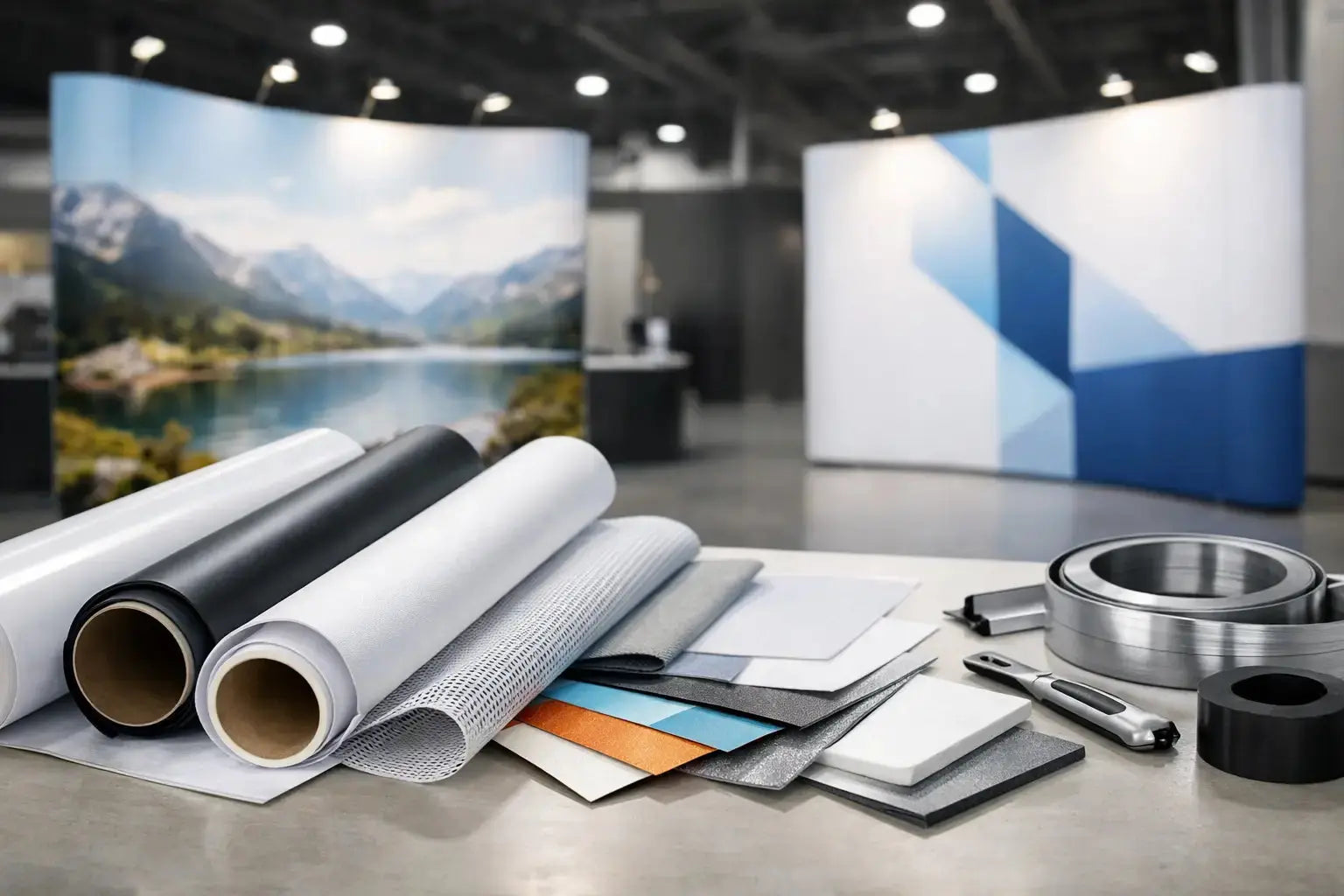
A backdrop that looks excellent in a product mockup can become a problem on the show floor fast. Glare from venue lighting, visible creases, difficult transport, or a frame that takes too long to install can all affect how your brand is seen. This guide to choosing exhibition backdrop materials is built for businesses that need the right result the first time, with fewer compromises on print quality, setup, and durability.
For most exhibitors, the material decision is not only about appearance. It affects portability, storage, reusability, installation time, and how consistently your graphics perform across different events. If your team is planning a trade show booth, conference backdrop, media wall, product launch display, or branded stage setup, choosing the right substrate early will save both time and reprint costs later.
How to use this guide to choosing exhibition backdrop materials
Start with the event conditions, not the artwork. A small indoor networking event has different demands than a multi-day exhibition with heavy foot traffic and repeated assembly. If you choose material based only on price or visual preference, you can easily end up with a backdrop that prints well but travels poorly, or one that installs quickly but lacks the premium finish your brand needs.
The better approach is to match the material to five practical factors: viewing distance, lighting, transport method, number of uses, and installation environment. Once those are clear, the best material category usually becomes obvious.
Fabric backdrops for a cleaner premium look
Fabric is one of the most widely used exhibition backdrop materials for good reason. It offers a smooth, professional presentation and is especially effective for brand spaces where image quality and finish matter. Stretch fabric and tension fabric systems are common for conference backdrops, photo walls, shell scheme enhancements, and portable display booths.
One of the main advantages of fabric is reduced glare. In exhibition halls with strong overhead lighting, this can make a major difference in how readable your graphics are from a distance. Fabric also tends to photograph well, which matters for press coverage, social media content, and branded event photos.
That said, fabric is not always the right choice for every setup. Some fabric materials require careful packing to avoid wrinkles, and not every system delivers the same level of edge definition for highly detailed graphic designs. If your artwork includes small text, intricate patterns, or strict brand color matching, print method and fabric type need close attention.
Fabric is usually a strong fit when you want a polished visual finish, frequent reuse, and a lightweight structure that is easier for event teams to transport.
PVC and vinyl backdrops for durability and strong color
PVC and vinyl remain popular because they are durable, cost-effective, and highly versatile. These materials are often used for large-format banners, branded walls, promotional displays, and exhibition graphics where bold color and structural stability are priorities.
The biggest strength of vinyl is toughness. It handles repeated use well, especially in environments where the backdrop may be rolled, moved, and reinstalled across multiple events. It also supports vivid graphics and can work well for brand-heavy designs that need strong contrast.
The trade-off is finish. Depending on the type selected, vinyl can produce reflections under direct lighting, which may affect visibility. It is also generally heavier than fabric, so transport and handling can become less convenient for larger displays. Some vinyl backdrops may show memory lines if stored improperly, which is worth considering if your event calendar involves frequent setup and takedown.
If your main goal is durability, bold print performance, and dependable use across repeated campaigns, PVC or vinyl is often the practical choice.
Rigid board materials for structure and sharp presentation
Some exhibition backdrops are better built from rigid panels rather than flexible media. Foam board, PVC board, and similar rigid substrates are often selected for freestanding branded panels, directional displays, product information walls, and modular exhibition structures.
Rigid materials offer a clean, flat display surface. That matters when your design includes precise lines, technical product visuals, or messaging that must stay crisp at close viewing range. They also help create a more architectural look, which can elevate the overall booth presentation.
However, rigid boards require more planning. They are less forgiving in transport, need more storage space, and may not be ideal if your team needs a portable system that travels often. For one-off installations or semi-permanent branded event environments, they can be highly effective. For roadshow-style events, they may be less efficient than fabric or rollable media.
What matters more than the material alone
Choosing a backdrop material is also about how it works with the full display system. A premium print on the wrong frame still creates problems. Before approving production, check how the material interacts with frame tension, mounting method, and final size.
A backdrop that spans a wide wall area may need a material that stays stable without sagging. A media wall used for photography may need a finish that minimizes reflection. A fast-paced exhibition build may need hardware that allows quick installation by a small team. These details matter as much as the substrate itself.
This is where procurement and marketing teams often benefit from supplier guidance. The right recommendation is usually based on usage, not just specification sheets.
Choosing by event type and business goal
If you are exhibiting at a trade show and need a portable branded wall for repeated use, fabric systems usually make sense because they balance visual quality and portability. If the display will stay in one place for a longer campaign period, rigid panels may offer a cleaner structured result. If budget control and heavy reuse are the top priorities, vinyl can be the most practical option.
For product launches, press events, and photo opportunities, the finish of the material becomes more important because the backdrop will appear in event photography. In these cases, low-glare fabric often performs better than reflective surfaces. For retail promotions or branded pop-up spaces, the right decision depends on whether the backdrop needs to move between locations or remain installed for an extended period.
In short, the best material depends on what the backdrop needs to do after printing. A good-looking display is only useful if it is also workable for your team.
Common mistakes in choosing exhibition backdrop materials
One common mistake is selecting based on price alone. Lower upfront cost can lead to higher replacement cost if the backdrop wrinkles easily, damages during transport, or fails to create the visual impact needed at the event.
Another issue is ignoring setup conditions. Ceiling height, venue access, lighting direction, and available staff all affect which material and display type will work smoothly. A backdrop that looks ideal on paper can become difficult if the venue setup window is short or the installation area is tight.
Artwork suitability is another factor buyers sometimes overlook. Not every material handles every graphic style equally well. Large blocks of brand color, gradient-heavy artwork, high-resolution photography, and text-led designs each behave differently depending on the print surface.
Questions to ask before placing your order
Before production starts, define where the backdrop will be used, how often it will travel, who will install it, and what finish your brand requires. You should also confirm final dimensions, frame compatibility, packing method, and whether the material is intended for short-term campaigns or long-term reuse.
If your business attends multiple exhibitions across Dubai or the wider UAE, it is worth choosing a material that balances visual consistency with practical transport. A slightly higher-spec option can save time and reduce replacement needs over a full event calendar.
For many companies, the fastest route to the right choice is sharing the actual use case rather than asking for a generic recommendation. Details like booth size, event duration, lighting conditions, and transport frequency lead to a more accurate material match.
At Printava, this is typically where the decision becomes clearer. Once the event setup, branding goals, and reuse requirements are known, the backdrop material can be selected with fewer revisions and better execution.
A well-chosen exhibition backdrop should do more than fill space. It should support faster setup, stronger brand presentation, and a cleaner event presence from the moment your team arrives. If you are planning your next display, get a quote today and choose a material that works as hard as your brand does.