
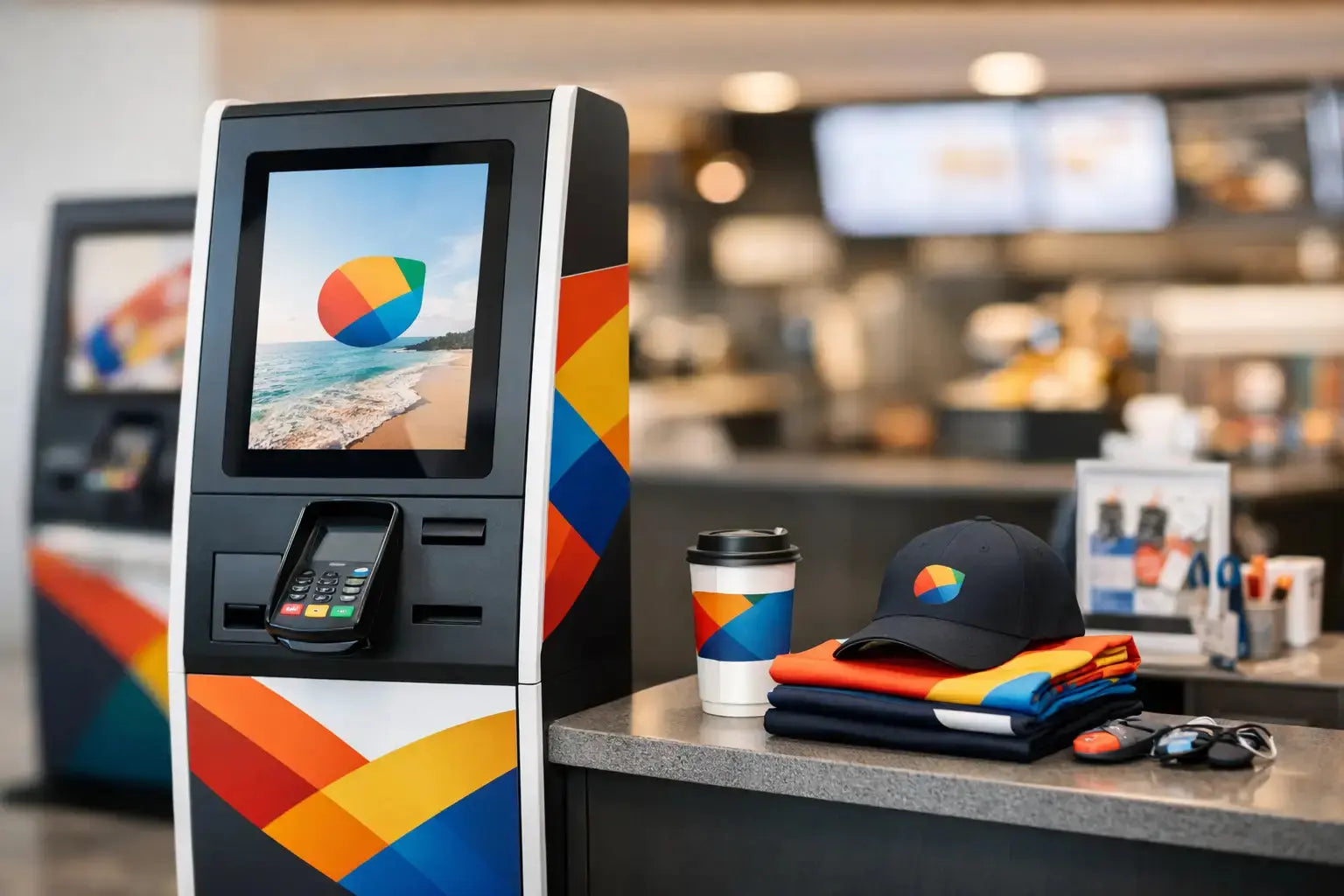
A kiosk has only a few seconds to make the right impression. In a mall walkway, exhibition hall, food court, or pop-up retail zone, customers decide fast. That is why kiosk branding solutions matter - not as decoration, but as a practical sales tool that shapes visibility, trust, and buying behavior.
For growing brands, the kiosk itself is rarely the full challenge. The real question is how to turn a compact footprint into a branded environment that looks professional, reads clearly from a distance, and supports day-to-day operations. Good branding helps people notice the kiosk, understand what is being offered, and feel confident enough to stop.
What kiosk branding solutions should actually do
Effective kiosk branding is not just about printing a logo on a counter panel. It should work across three levels at once. First, it must attract attention in a busy environment. Second, it must communicate the offer quickly. Third, it should support a consistent brand experience from the first glance to the point of purchase.
That means every surface has a job. Front panels can carry bold brand colors and primary messaging. Side panels can reinforce product categories or promotional offers. Backdrops, header signage, hanging graphics, and lightbox elements help increase visibility above eye level, which is often essential in high-traffic areas.
The strongest kiosk branding solutions also account for movement. People do not approach kiosks the way they approach stores. They pass by from different angles, often while distracted. If the messaging only works from one side, or the visual hierarchy is weak, the kiosk loses opportunities before staff even get a chance to engage.
The core elements of kiosk branding solutions
A well-branded kiosk usually combines print, signage, surface graphics, and display materials into one coordinated setup. The exact mix depends on the location, use case, and duration of the campaign.
Branded vinyl graphics and wraps
Vinyl graphics are often the foundation of kiosk branding. They can be applied to counters, side panels, storage units, and structural surfaces to create a clean, branded finish. For many businesses, this is the fastest way to convert a plain kiosk into a recognizable selling space.
The benefit is flexibility. Vinyl can support full-color brand visuals, campaign messaging, product imagery, and directional cues without requiring a full rebuild. The trade-off is that artwork needs to be planned around actual panel dimensions, edges, corners, and access doors. A strong design on screen can fail on-site if installation details are ignored.
Header boards and elevated signage
If customers cannot spot the kiosk from a distance, the branding is underperforming. Header boards, top signs, and suspended graphic elements solve this problem by lifting the brand into the sightline of passing traffic.
This matters even more in crowded venues where nearby kiosks compete for attention. Clear naming, simple messaging, and readable typography usually perform better than overly detailed visuals. In these cases, less design often creates more visibility.
Backdrops and promotional panels
For kiosks used at exhibitions, activations, or seasonal retail campaigns, a backdrop can add structure and create a more complete branded environment. It helps frame the kiosk, supports photography, and gives more room for campaign communication.
Not every kiosk needs a large backdrop. In compact retail spaces, it may feel crowded. But where space allows, branded panels behind or beside the kiosk can improve professionalism and make even a temporary setup feel established.
Countertop displays and point-of-sale branding
Customers who stop at a kiosk need a fast path to understanding. Countertop signs, acrylic holders, tent cards, shelf strips, and branded product displays help guide the final decision. These details are small compared to wall graphics, but they often influence conversion more directly.
This is where pricing, product names, QR-based menus, limited-time offers, and feature highlights should be organized carefully. If the front-facing branding brings people in, the countertop materials help close the sale.
How to choose the right kiosk branding setup
The best kiosk branding solutions depend on how and where the kiosk will be used. A permanent mall kiosk has very different needs from a weekend event stand or a seasonal product activation.
For long-term retail use, durability matters more. Materials should withstand repeated cleaning, frequent contact, and extended exposure to indoor lighting. Finishes should look polished and remain consistent over time. In these cases, businesses usually benefit from a complete visual system rather than one-off printed pieces.
For short-term campaigns, speed, portability, and easy replacement are often more important. Messaging may need to change with promotions, product launches, or events. Removable graphics, modular display components, and quickly installed branding can be the smarter commercial choice.
Budget also changes the answer. Some brands need a full transformation with wraps, signage, display accessories, and supporting print. Others only need selected upgrades that improve visibility without replacing the entire setup. The right supplier should help prioritize what will make the biggest visual impact first.
Design decisions that improve results
A kiosk does not give you much space, so design discipline matters. The most common mistake is trying to say too much. A crowded kiosk with too many messages, offers, and visual elements becomes harder to read, not more persuasive.
A better approach is to build around one primary message, one strong brand signal, and one or two clear supporting points. That might mean leading with the business name and product category, then using side panels for offers or key benefits. It might also mean simplifying the color palette so the display feels cleaner from a distance.
Typography should be readable at walking speed. Product visuals should support the offer, not dominate every surface. If a kiosk serves multiple products or services, zoning helps. Assign specific areas for branding, offers, pricing, and customer action so nothing competes unnecessarily.
Lighting is another factor buyers sometimes overlook. In indoor venues, reflective surfaces, shadows, and inconsistent overhead lighting can affect how branding appears throughout the day. Matte finishes, high-contrast text, and tested color output can make a significant difference in readability.
Why consistency matters across every printed element
Customers notice when a kiosk looks pieced together. A strong counter graphic paired with mismatched signs, different fonts, or off-brand promotional materials weakens trust. Even if the products are good, the setup may feel temporary or unprofessional.
That is why kiosk branding should be treated as part of a wider brand system. Staff badges, packaging, stickers, labels, takeaway bags, menus, and promotional handouts should all align visually with the kiosk itself. Consistency creates recognition, and recognition supports repeat business.
For event organizers and multi-location campaigns, this becomes even more important. If several kiosks are used across different venues, standardized branding helps maintain quality and makes rollout easier to manage.
Working with a supplier on kiosk branding solutions
Execution matters as much as design. A supplier should be able to manage accurate sizing, print production, material recommendations, finishing, and installation planning with minimal back-and-forth. That saves time for marketing teams, operations managers, and procurement teams who need a reliable result without unnecessary delays.
It also helps to work with a partner who understands related materials beyond the kiosk surface itself. A campaign may require branded stickers, promotional signage, packaging, uniform branding, or event display support to complete the customer experience. Handling those items together usually improves consistency and reduces coordination issues.
For businesses in Dubai and across the UAE, speed and professionalism are often just as important as visual quality. Printava supports companies that need kiosk graphics, branded display materials, and related print assets delivered with clear communication and practical execution.
When kiosk branding is worth the investment
If a kiosk is meant to generate sales, launch products, support sampling, or represent the brand in public, branding is not an optional extra. It directly affects whether people notice the kiosk, understand the offer, and trust the business enough to buy.
That does not mean every kiosk needs the most complex setup. It means the branding should match the goal. Sometimes a clean wrap and bold header sign are enough. In other cases, a full branded environment is needed to compete in a crowded venue. The smart move is to build around visibility, clarity, durability, and ease of use.
If your kiosk is doing the job operationally but not attracting the right attention, the issue may not be foot traffic. It may be presentation. Get the branding right, and a small footprint can start working much harder for your business. Get a quote today and plan a kiosk setup that looks sharp, communicates fast, and supports sales from the first glance.