
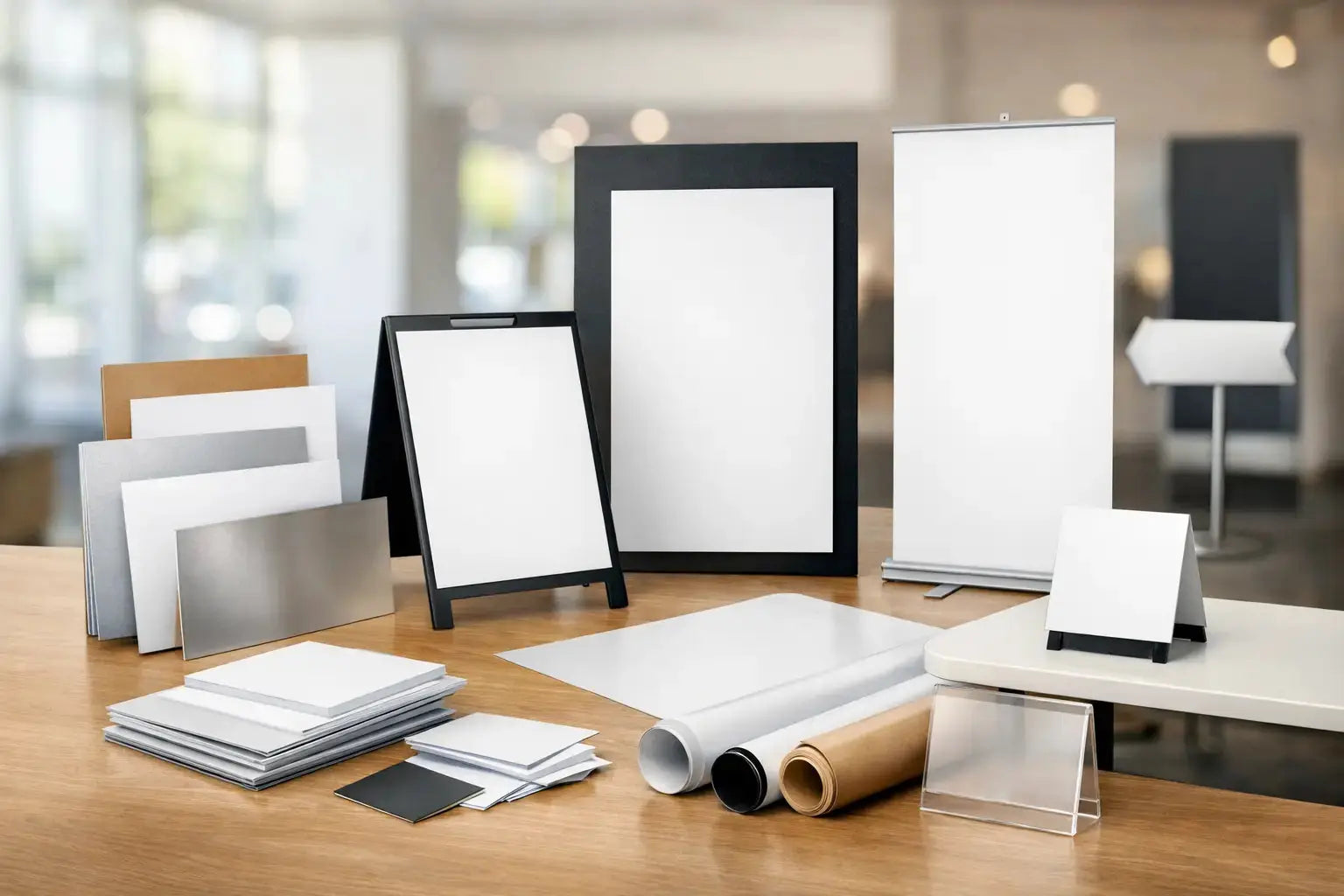
A registration desk backed by an undersized banner creates confusion before guests have even checked in. A large display printed on the wrong material can be equally frustrating if it curls, reflects venue lighting, or becomes difficult to transport. This guide to event signage materials and sizes helps marketing teams, procurement managers, and event organizers choose displays that look professional, fit the venue, and support a smooth event setup.
The right choice is not simply the biggest sign available. It depends on viewing distance, venue rules, how long the event runs, whether the signage will be reused, and who needs to move and install it. Planning those details early protects brand consistency and avoids last-minute substitutions.
Start With the Sign's Job at the Event
Before selecting a material or size, define what each sign needs to do. Directional signs need to be read quickly from a distance. Sponsor backdrops need clean, repeatable logos for photography. Product displays need to hold attention at close range, while outdoor signs must handle heat, wind, and regular handling.
For most business events, signage falls into a few working categories: entrance and registration displays, wayfinding, promotional displays, branded backdrops, booth graphics, and point-of-sale messaging. A single event may require all of them, but they should not all use the same format.
A useful rule is to match the sign to the viewing moment. If attendees will walk past it at close range, smaller formats and detailed messaging can work well. If they need to spot it across a hall, prioritize large type, high contrast, and a format with enough physical presence to rise above surrounding booths.
Event Signage Materials and Sizes: The Core Options
Roll-up banners for portable promotion
Roll-up banners are a practical choice for receptions, conferences, retail activations, training sessions, and exhibition booths. The printed graphic retracts into a base, making storage and transport straightforward. They work especially well when a team needs branded messaging that can be set up quickly without tools.
Common visible sizes include 33 x 79 inches, 33 x 86 inches, and wider formats such as 47 x 79 inches. A standard 33-inch-wide banner suits a registration desk, hallway, or small booth. Wider banners give campaigns more visual weight but require clear floor space and should not block visitor flow.
For the print surface, smooth banner media is generally preferred indoors because it presents logos, text, and product imagery cleanly. Choose a sturdy stand and cassette for displays that will travel to several events. A roll-up banner is less suitable for exposed outdoor locations where wind can affect stability.
Foam board and rigid display boards for clear messaging
Foam board is lightweight and works well for indoor directional signs, welcome boards, menu displays, presentation boards, and short-term promotional messaging. It provides a flat surface that photographs well and can be mounted on easels, walls, counters, or display stands.
Typical sizes include 18 x 24 inches, 24 x 36 inches, and 36 x 48 inches. An 18 x 24-inch board is useful for counter communication or close-range instructions. A 24 x 36-inch board is a dependable wayfinding size for a corridor or registration area. For a stage-side sign or large welcome message, 36 x 48 inches offers stronger visibility without becoming difficult to handle indoors.
Foam board is best for controlled indoor environments. It is not the right choice where moisture, frequent handling, or outdoor exposure is expected. For more demanding applications, consider a rigid plastic board instead.
PVC and rigid plastic boards for durability
PVC foam board and similar rigid plastic materials are a strong option for event signs that need to remain flat, withstand regular handling, or be used in semi-outdoor environments. They are commonly selected for directional signage, booth panels, sponsor boards, venue instructions, and long-running promotional installations.
A thickness of 3 mm is often suitable for standard mounted signs, while 5 mm provides a more substantial feel for freestanding or repeatedly handled displays. Size selection still matters: a large rigid board can be visually effective, but it may need a frame, stand, or secure mounting method. Confirm how the venue permits signs to be fixed before production begins.
PVC boards are more durable than foam board, but they are also less convenient for teams carrying multiple large pieces through busy event halls. If portability is the priority, a fabric display or roll-up banner may be a better fit.
Fabric backdrops for premium branded spaces
Fabric backdrops are well suited to photo areas, press walls, sponsor displays, stage backgrounds, and exhibition spaces where a polished finish matters. The material is lightweight, reduces glare compared with some rigid surfaces, and can be paired with a tension frame for a clean, professional presentation.
Popular backdrop sizes include 8 x 8 feet, 10 x 8 feet, and 10 x 10 feet. An 8 x 8-foot backdrop suits a compact photo moment or booth wall. A 10-foot-wide format gives groups more room for photographs and provides better coverage behind a reception area or stage. The final choice should account for ceiling height, lighting, access routes, and the camera angles expected at the event.
Fabric is a good investment for campaigns that will appear at multiple venues. It packs more efficiently than many rigid systems, though the frame and tensioning process should be planned into setup time. Keep artwork simple enough to read on camera, with logos placed at repeatable heights for event photography.
Vinyl banners for flexible indoor and outdoor use
Vinyl banners remain a useful format for launches, outdoor promotions, construction-adjacent events, sports activations, and large directional messaging. They can be produced in custom dimensions and finished with hems, eyelets, or pole pockets based on the installation method.
For an entrance banner, 3 x 6 feet is a common starting point. For a fence, facade, or larger outdoor message, 4 x 8 feet and 5 x 10 feet provide greater impact. Bigger is not automatically better: a banner that is too large for its mounting points can sag, while small text becomes ineffective when viewed from a parking area or road.
Outdoor vinyl requires practical planning. Ask where it will be installed, whether it will be exposed to wind, and how it will be secured. Mesh-style banner material can be appropriate for windy areas because it allows air to pass through, while solid vinyl typically provides stronger color density where wind exposure is limited.
Choose Size by Viewing Distance, Not Guesswork
Sign size should follow the distance from which people need to read it. As a working guide, lettering around 1 inch high is typically readable from roughly 10 feet away under favorable conditions. For a message viewed from 30 feet away, use headline lettering closer to 3 inches high. Venue lighting, crowd density, font style, and contrast can all change the result.
Keep essential messages short. A directional sign should lead with the destination, such as “Registration,” “Conference Hall,” or “VIP Entrance,” rather than a full sentence. A promotional banner needs one campaign message, one visual focus, and a clear call to action. When every detail is given equal importance, nothing is easy to read.
Also consider physical placement. A floor-standing sign near a doorway should not create an obstruction. Ceiling-hung signage may require venue approval and specific hardware. Signs behind a reception desk need enough height to remain visible above staff and equipment.
Plan Artwork, Finishing, and Setup Together
Artwork is only one part of event signage production. A strong file can still underperform if the finishing does not match the setup. Eyelets need to align with mounting points. Backdrop graphics need correct bleed and frame dimensions. Rigid boards may need drilled holes, easel support, or adhesive backing. Roll-up banners require a safe margin at the bottom where the graphic enters the cassette.
Build a signage schedule that includes proof approval, production, delivery, and venue installation. For multi-day exhibitions, keep spare small signs and replacement graphics where possible. It is also wise to confirm loading access, elevator dimensions, and venue delivery rules before ordering oversized boards or frames.
For brand consistency, use the same approved logo files, color references, typography, and campaign language across every format. A visitor should recognize the brand whether they see a small counter sign, a booth wall, or a large entrance banner.
Get the Right Signage Mix for the Venue
The most effective event signage plan combines formats rather than relying on one large display. A branded backdrop can create a focal point, roll-up banners can carry campaign messages, and rigid boards can guide visitors through the space. Each format has a specific job, material requirement, and size range.
Share your venue layout, intended placement, artwork, and event dates when requesting a quote. Printava can help match materials, sizes, finishing, and display systems to your event requirements across Dubai and the UAE. Start with the signs attendees need to see first, then build outward so every display supports a clear, consistent visitor experience.