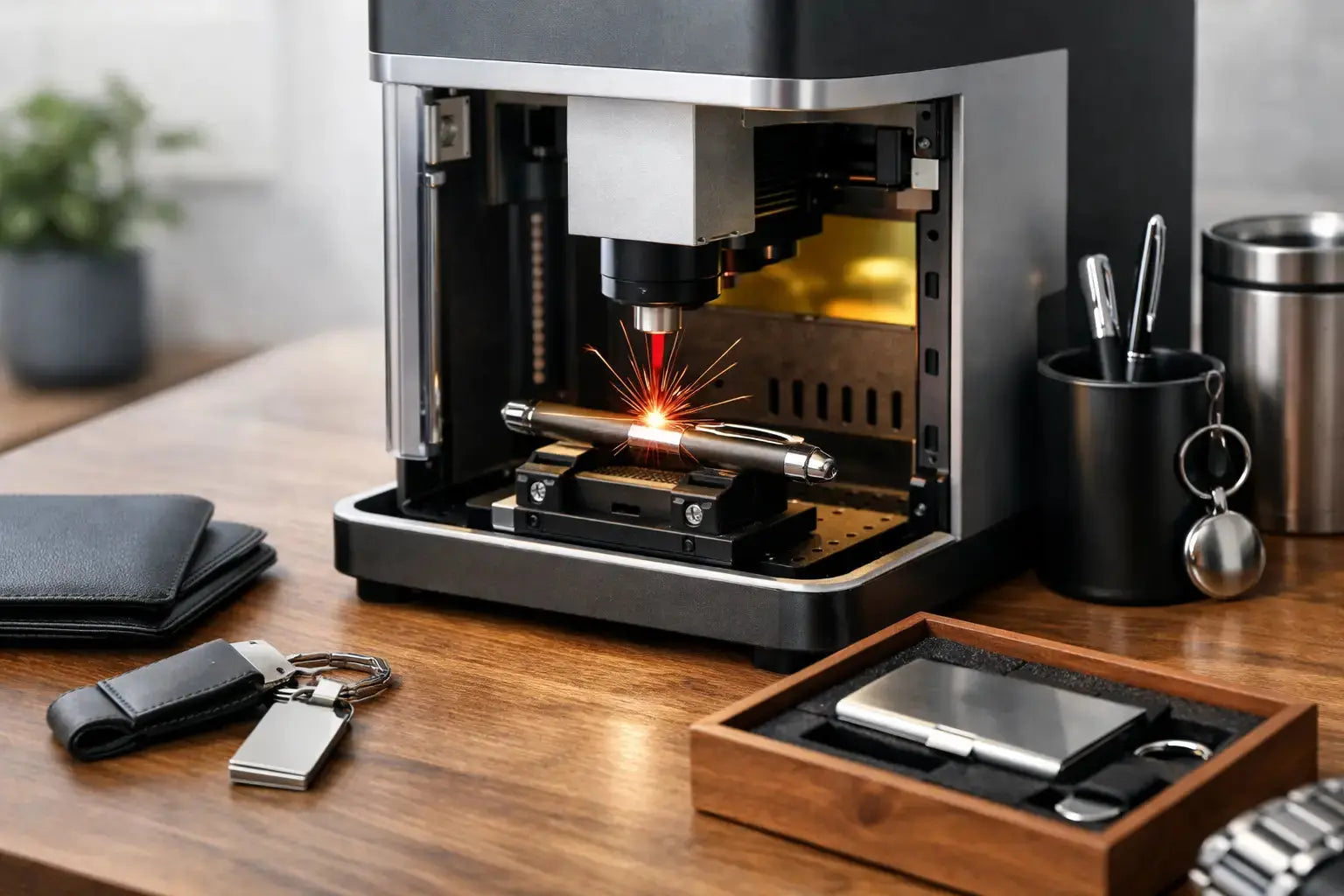
A premium metal pen with a crisp recipient name, a bamboo desk organizer carrying a subtle company mark, or a leather-finish notebook with a clean logo can make a corporate gift feel considered rather than standard. The right laser engraving machine for corporate gifts helps businesses achieve that permanent, refined finish at the scale their campaign requires. The wrong choice can create slow production, inconsistent detail, or limits on the products your team wants to personalize.
For procurement teams and marketing departments, the decision is not simply about buying a machine. It is about matching engraving capability to gift materials, order volumes, artwork standards, workspace requirements, and delivery deadlines. This guide focuses on the practical questions that lead to more reliable branded gift programs.
What a Laser Engraving Machine for Corporate Gifts Must Do
Laser engraving creates a permanent mark by removing or altering the surface of a material. Its appeal for corporate gifting is clear: it can add logos, names, dates, taglines, and event details without relying on printed inks or separate labels. The result is often especially effective on executive gifts, employee recognition items, onboarding packs, client appreciation gifts, and event merchandise.
However, “laser engraving” covers several technologies. Material compatibility should lead the decision. A machine that produces excellent results on coated metal drinkware may not be the best fit for acrylic awards, wood boxes, or leatherette folders. Gift ranges are rarely limited to one material, so buyers should look at their planned product mix before comparing specifications.
The key question is straightforward: what will you engrave most often over the next 12 months? A business focused on insulated bottles and metal pens needs a different setup from one producing acrylic desk awards, branded wooden gift boxes, and custom name badges.
CO2, Fiber, and UV: Choose by Material
CO2 lasers are commonly used for non-metal materials such as wood, bamboo, paperboard, acrylic, glass, fabric, and many leatherette surfaces. They are a practical choice where packaging, plaques, wooden accessories, or acrylic gifts are central to the program. They can also mark certain coated metal items by removing the coating to reveal a contrasting base.
Fiber lasers are generally better suited to metals, including stainless steel, aluminum, brass, and many metal-coated promotional products. They are a strong fit for pens, keychains, business card holders, tools, flasks, and metal awards. For a company that frequently requires sharp, fine logos on metal products, fiber capability deserves close attention.
UV lasers can mark a broader range of sensitive materials with very fine detail and limited heat impact. They may suit specialist applications, but the investment and operating considerations are different. For most corporate gift programs, the choice usually comes down to CO2, fiber, or a production arrangement that uses the appropriate process for each product.
Do not assume a single machine will cover every gift category at the same finish standard. A mixed-material catalog may justify separate capabilities, while a lower or variable volume may be better handled through a professional branding partner with established production workflows.
Start With the Gift Range, Not the Machine
A common purchasing mistake is selecting equipment first and trying to fit the gift range around it later. Start by reviewing the actual items your company purchases or plans to offer. Consider dimensions, surface shape, material, coating, and the branding area available.
Flat products are generally easier to position consistently. Pens, tumblers, curved bottles, and cylindrical packaging need suitable fixtures or rotary attachments to keep the engraving aligned. Without the correct accessory, a logo can appear uneven or distorted around a curved surface. That is a production issue, not a minor detail, especially for a client-facing gift set.
Artwork also affects the outcome. Engraving performs best with clean vector artwork, clear line weights, and simplified marks that remain recognizable at small sizes. A highly detailed logo that looks good on a large exhibition wall may lose clarity on a pen barrel. Before approving a campaign, test the intended logo, recipient name format, and placement at the real production size.
For corporate gifting, presentation matters as much as permanence. Consider how engraving will sit beside other branded components, such as printed sleeves, custom boxes, ribbon, thank-you cards, and event packaging. The strongest gift programs treat each item as part of one consistent brand experience.
Evaluate Production Volume and Workflow
A machine’s engraving speed is only one part of output. Real production time includes artwork preparation, machine setup, product positioning, focus adjustment, proofing, engraving, cleaning, quality checks, and packing. If every item requires an individual name, variable-data handling becomes a major factor.
For a small internal requirement, a compact workflow may be enough. For event gifting, staff onboarding, seasonal client campaigns, or multiple branches ordering branded items, capacity must be assessed more carefully. A machine that handles one item well may not support a campaign involving hundreds of personalized gifts within the required schedule.
Ask these operational questions before committing:
- How many items must be produced per day during peak campaign periods?
- Will each product use the same logo, or will names and job titles vary?
- Is a rotary attachment needed for bottles, mugs, or cylindrical gifts?
- Who will prepare artwork, operate the equipment, and approve samples?
- Is there sufficient space for ventilation, safe handling, storage, and finished-goods packing?
Variable Names Need a Controlled Process
Personalized corporate gifts are valuable because they acknowledge the recipient directly. They also introduce more room for error. A misspelled name, incorrect title, or duplicated design can undermine an otherwise premium gift.
Use an approved spreadsheet as the single source for names, titles, departments, and any other variable information. Keep a clear proofing stage before production begins, and define who has final sign-off. For multilingual names or Arabic and English personalization, confirm font support, character rendering, and layout before the full order proceeds.
A structured naming workflow is particularly useful for employee awards, conference attendee gifts, VIP client packs, and executive welcome kits. The engraving itself may take seconds, but accurate data handling is what protects the finished result.
Quality Is Defined by Detail, Contrast, and Consistency
A clean engraving is not only about whether the logo is visible. It should have appropriate contrast for the material, even depth or marking quality, accurate positioning, and no unwanted marks around the design. Different materials respond differently, and even items within the same category can vary by coating or finish.
Sampling is therefore essential. Request or create a physical sample on the exact product, not merely a similar one. Review the logo at normal viewing distance and close up. Check whether thin lines hold, whether small text remains readable, and whether the mark complements the product color.
On metal gifts, engraving may produce a subtle tonal mark rather than a high-contrast color. That can look premium and understated, but it may not suit every brand or logo. On coated drinkware, the exposed base can create stronger contrast. On wood and bamboo, natural grain variation means no two results will look identical. This is often part of the appeal, but it should be understood before approval.
Placement deserves the same attention. A centered logo on a presentation box, a discreet mark near the clip of a pen, or a name positioned below an award message each creates a different impression. Use product mockups for direction, then confirm final placement on a physical sample.
Internal Equipment or Professional Gift Personalization?
Owning a laser system can make sense for businesses with frequent, predictable demand, trained operators, and a controlled range of compatible products. It offers direct scheduling control and can be useful where small runs are needed regularly.
Outsourcing is often the more efficient route for companies that order gifts around events, campaigns, annual recognition programs, or client milestones. It reduces the need to manage equipment, testing, production staffing, and finishing. It can also provide access to a wider selection of gift materials and branding methods than a single machine supports.
The best choice depends on volume, product complexity, available space, and how often personalization is needed. For many businesses, the priority is not operating engraving equipment. It is receiving approved, presentation-ready gifts that arrive aligned with the campaign plan.
Printava supports UAE businesses with branded corporate gifts and coordinated presentation materials, helping teams select practical products and personalization options for their audience, budget, and deadline. Early planning gives more room to review samples, refine artwork, and organize packaging across the full order.
Plan the Brief Before Requesting a Quote
A clear brief speeds up product selection and reduces revisions. Include the event or campaign purpose, recipient profile, required quantity, desired delivery date, logo files, personalization details, preferred gift categories, and any packaging requirements. If you have brand guidelines, share approved colors, clear-space rules, and usage restrictions from the beginning.
It also helps to separate essential requirements from preferences. For example, permanent name personalization and a premium metal finish may be essential, while a specific box color may be flexible. This allows the supplier to recommend suitable options without compromising the key outcome.
Corporate gifts work best when the branded mark feels intentional, the recipient details are accurate, and the finish suits the product. Start with the experience you want the recipient to have, then choose the engraving method and production route that can deliver it reliably. Get a quote today with your quantity, product preferences, and campaign date, and build a gift program that represents your brand with care.