
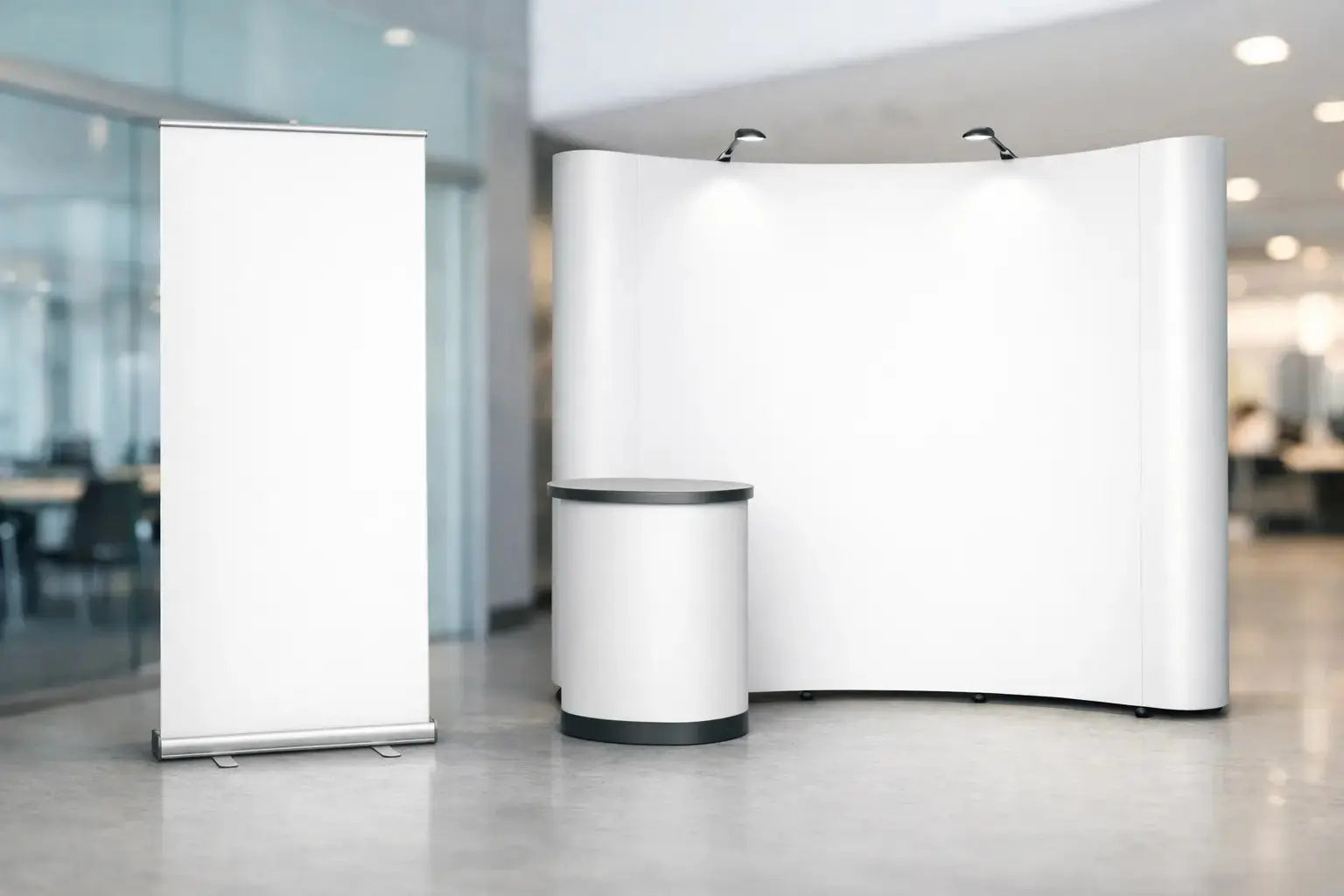
A tight event deadline changes how you choose display hardware. When the team needs something branded, portable, and ready to set up fast, the real question is usually roll up banner vs pop up display - and the right answer depends on where it will be used, how often it will travel, and how much visual impact you need.
Both products are proven business display tools. Both can carry strong branding, work well at exhibitions, and support launches, conferences, retail promotions, and reception areas. But they are not interchangeable. One is built for speed and simplicity. The other is built for presence.
Roll up banner vs pop up display: the core difference
A roll up banner is a single printed graphic that retracts into a slim base cassette. It is usually vertical, compact, and designed for quick transport and setup. You pull the banner up, fix it to the support pole, and it is ready in minutes.
A pop up display is a larger branded backdrop system. It uses a collapsible frame and printed graphic panels or a fabric graphic to create a broader display wall. It takes more space and more setup than a roll up banner, but it gives you a much stronger branded background for booths, presentations, and exhibition stands.
If you need a simple message beside a registration desk, product shelf, or meeting room entrance, a roll up banner usually fits better. If you need to define a branded area, support a sales team at a trade show, or create a proper event backdrop, a pop up display is often the better investment.
When a roll up banner makes more sense
A roll up banner works best when portability is the priority. It is easy to carry between venues, fits into smaller cars, and stores neatly in offices or stock rooms. For businesses that attend regular meetings, mall activations, in-store promotions, or one-day events, this convenience matters.
It also suits campaigns where the message needs to be simple and immediate. If your artwork focuses on a logo, headline, offer, QR code, or a short product message, the vertical format keeps communication clear. In busy environments, that kind of focused display can outperform larger graphics that try to say too much.
Budget is another factor. If a team needs multiple branded displays for different branches, sales reps, or event points, roll up banners are often the more practical option. They allow consistent branding across locations without requiring a full exhibition setup.
That said, there are limits. A roll up banner does not create a visual backdrop. It will not anchor a booth the way a wider display wall can. And if the event space is large, a single banner can feel visually light unless used in pairs or as part of a broader display package.
Best use cases for roll up banners
Roll up banners are a strong fit for reception areas, hotel conferences, retail entrances, training rooms, product launches, temporary promotions, and directional branding. They are also useful when setup must be handled by one person without tools or technical support.
For companies working across Dubai and the wider UAE event market, this matters because many activation spaces have tight installation windows. A display that can be unpacked and positioned fast helps keep setup efficient.
When a pop up display is the better choice
A pop up display is designed for stronger visual coverage. Instead of presenting one narrow message panel, it gives your brand a larger surface area that feels more established and professional in exhibition settings.
This matters when your team is exhibiting rather than simply attending. At trade shows, career fairs, business expos, and product showcases, the background behind your team shapes first impressions. A pop up display makes the stand look complete, even before you add counters, brochure holders, or product samples.
It is also more effective when you need to present multiple visual elements. A broader display can support product imagery, service categories, brand messaging, and a cleaner overall layout without crowding the design. For companies with more complex offerings, that extra space improves communication.
The trade-off is logistics. Pop up displays are less compact than roll up banners, and setup can require more care depending on the frame and graphic style. They are still portable, but not in the same grab-and-go way. If your team is moving between several short appointments in one day, a pop up display may feel excessive.
Best use cases for pop up displays
Pop up displays are best for exhibition booths, stage backdrops, media walls, conference branding, sponsor walls, and high-visibility launch events. They are especially effective when photography matters, because they create a cleaner branded background for team photos, interviews, and guest engagement.
Size, footprint, and visibility
One of the biggest decision points is floor space. A roll up banner has a small footprint and fits where space is limited. That makes it useful for corridors, counters, and compact retail areas where a larger structure would obstruct movement.
A pop up display needs more room, but that space works in your favor when visibility is the goal. It helps define a branded zone and can be seen from farther away, especially in crowded exhibition halls.
If your event stand is small, a roll up banner may be enough. If your event stand needs a back wall, a pop up display is the stronger solution. The choice is not just about size on paper. It is about how much visual territory your brand needs to claim.
Setup time and ease of handling
For speed, roll up banners are hard to beat. One person can usually carry, open, and position the display in a few minutes. This is ideal for field teams, sales presentations, and rotating activations.
Pop up displays are still manageable, but they involve more components and more positioning. Some systems are very user-friendly, especially fabric-based versions, while others take more attention to align graphics correctly. For high-frequency event use, it is worth choosing a display format your team can confidently handle without delays.
If your internal team will set it up often, simplicity should carry real weight in the decision.
Graphic impact and brand presentation
This is where the gap becomes more obvious. A roll up banner is direct and efficient. A pop up display is immersive and more visually commanding.
If your objective is to support a sales conversation, promote one offer, or identify your location, a roll up banner often does the job well. If your objective is to make the stand itself feel branded, polished, and photo-ready, a pop up display has a clear advantage.
Design quality matters for both. A well-produced banner with sharp print, proper bleed, readable typography, and a stable base will perform better than a poorly planned large display. Bigger does not automatically mean better. The display has to match the event objective and the viewing distance.
Cost, longevity, and value
From a purchasing perspective, roll up banners are usually the lower-cost entry point. They are practical when you need several units, frequent message changes, or simple campaign branding.
Pop up displays cost more because they offer more structure and larger visual coverage. But value should be measured against use case, not just unit cost. If one pop up display helps your stand look complete at repeated exhibitions, it may deliver stronger long-term return than several smaller displays used in the wrong setting.
Durability also depends on handling and transport. A roll up banner can perform well for repeated use if stored properly and handled carefully. A pop up display can also last through many events, particularly when packed and installed correctly. Neither should be treated as disposable if brand presentation matters.
So which one should you order?
Choose a roll up banner if you need portability, fast setup, compact storage, and a cost-effective branded display for everyday business use. It is the smart option for receptions, in-store promotions, sales visits, conferences, and supporting signage around an event.
Choose a pop up display if you need a branded backdrop, stronger booth presence, broader graphic storytelling, and a more substantial event presentation. It is the better fit for exhibitions, launches, sponsor walls, and spaces where your display needs to carry more visual weight.
In some cases, the best answer is not roll up banner vs pop up display, but both. A pop up display can anchor the main booth while roll up banners extend messaging at entrances, product zones, or registration points. That combination creates consistency across the space without overcomplicating setup.
If you are ordering for a campaign, think beyond the product name. Consider venue size, setup window, transport method, audience flow, and whether the display needs to inform, attract, or frame the brand. That is usually where the right choice becomes clear.
If you need business-ready exhibition and display printing with practical guidance on size, material, and setup, Printava can help you choose the format that fits the job and keeps your branding sharp from first setup to final event. Get a quote today and order the display that works as hard as your team does.