
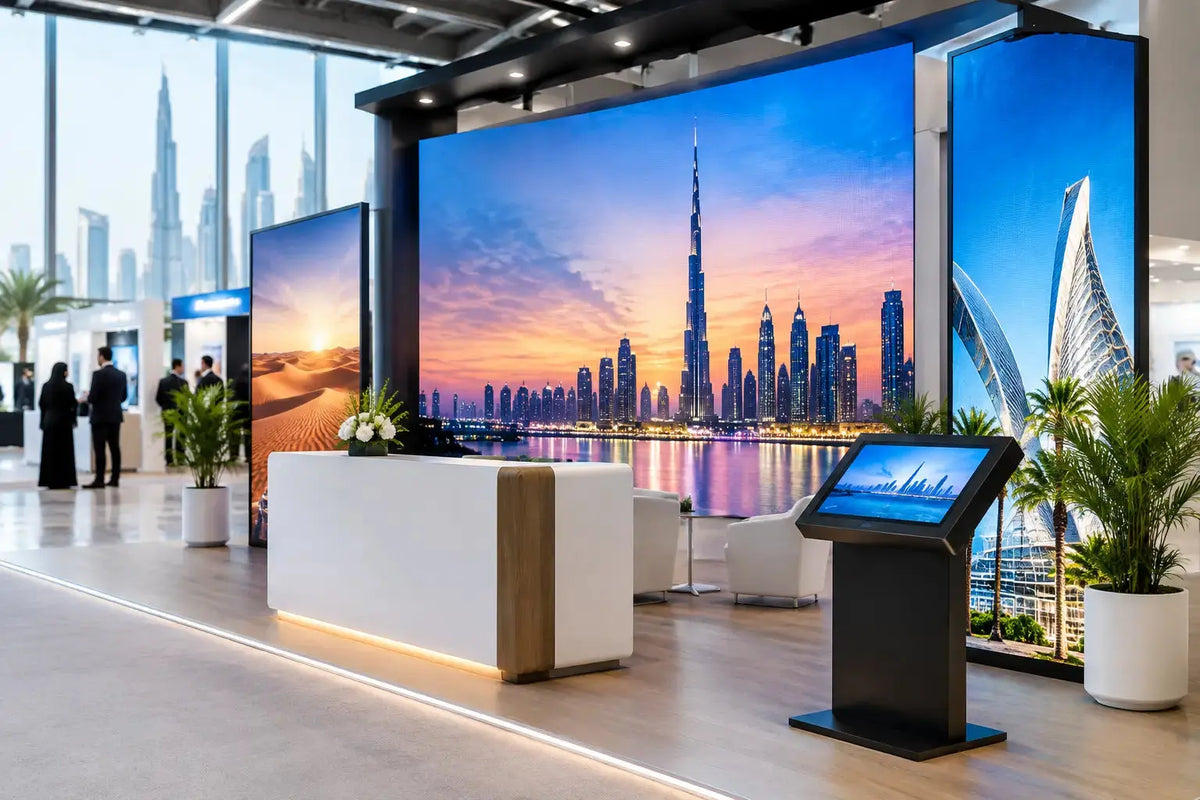
A busy exhibition floor gives a brand only a few seconds to earn attention. The most useful event display technology trends are not about adding screens for their own sake. They help exhibitors make their message easier to see, understand, photograph, and act on - while keeping setup, transport, and staffing practical.
For marketing teams and event organizers, the priority is a display system that supports a clear commercial goal: introduce a product, capture qualified leads, direct visitors to a demonstration, or reinforce brand credibility. The right mix of printed graphics, digital content, and interactive elements can do that without turning a booth into a complicated production.
LED displays are becoming a focal point, not the whole stand
LED walls and digital screens have moved beyond large-scale conference stages. Compact LED panels, mounted displays, and digital signage now give brands a flexible way to show motion, product visuals, menus, event schedules, and customer stories. They are particularly effective where static graphics alone cannot explain a changing offer or a technical service.
The practical advantage is content control. A sales team can switch from a brand film to a product specification, a live social feed, or a time-sensitive promotion without replacing printed panels. For multi-day events, this makes the display feel current even when the physical stand remains the same.
However, screen size should match viewing distance and booth space. A bright LED wall can pull attention from across an aisle, but it may be unnecessary for a compact tabletop activation. It also needs a clear content plan. Fast-cut videos and dense slides can be difficult to follow in a loud exhibition environment. Short loops, large type, strong contrast, and captions usually perform better.
Printed backdrops, fabric displays, branded counters, and freestanding signage still do essential work around the screen. They frame the digital element, carry the core brand identity, and ensure the stand remains recognizable if the screen is off or visitors view it from an angle.
QR codes are evolving into useful event touchpoints
QR codes are now a standard part of event display planning, but their value depends on what happens after the scan. A code placed on a roll-up banner or product stand should lead to one clear destination: a product catalog, booking form, price request page, digital brochure, campaign landing page, or event-only offer.
A generic homepage creates extra steps and loses momentum. A focused landing page gives the visitor an immediate reason to continue. For B2B exhibitors, this can be a downloadable specification sheet, a meeting request form, or a concise product comparison.
Placement matters as much as the destination. Put the code where people can scan it comfortably without blocking the aisle. Add a short instruction beside it, such as “Scan for product specifications” or “Book a consultation.” The code needs sufficient contrast, a quiet background, and enough clear space around it to scan reliably.
QR-enabled displays also make event follow-up more measurable. Separate codes for different products, zones, or campaigns can indicate which message generated the strongest interest. That information helps marketing teams improve the next event rather than relying only on general footfall estimates.
Event display technology trends favor modular systems
One of the most commercially sensible trends is the shift toward modular display systems. Rather than producing a completely new stand for every exhibition, businesses are choosing reusable frames, interchangeable fabric graphics, portable counters, and adaptable shelving. The same core system can be configured differently for a conference, retail activation, product launch, or recruitment event.
This approach supports brand consistency while giving campaigns room to change. A company may retain its main backdrop structure and update only the graphic skins, product panels, or counter wraps for a new service line. It is also easier to store, transport, and set up than a heavily customized single-use build.
The trade-off is that modular systems require planning from the start. Sizes, connector types, lighting positions, and graphics need to work together. Before ordering, consider how often the stand will be reused, whether team members will set it up themselves, and which event footprints are most common. A 3-meter backdrop may suit one venue well but be too large for a smaller corporate activation.
For brands attending several events a year, durability and replaceable graphic components are often better buying criteria than novelty alone.
Interactive displays should solve a visitor problem
Touchscreens, tablets, product configurators, and interactive kiosks can give attendees a more active role in the booth. They work best when they answer a question quickly: Which product option fits this requirement? What does the service process look like? Which package should a buyer request a quote for?
For example, a real estate company might use a screen to let visitors explore unit types, while a packaging supplier could present material options and finish samples through a guided digital catalog. The screen should support the sales conversation, not replace it.
Avoid creating a long self-guided experience that requires a visitor to stand still for several minutes. Exhibition audiences are often moving quickly, and staff need to be able to step in naturally. A concise interface with three or four clear choices is more effective than a full website copied onto a kiosk.
Technology also needs an operational backup. Confirm power access, cable management, device security, internet requirements, and offline content availability before the event. A professionally printed display with a working tablet is more dependable than a complex activation dependent on unstable connectivity.
Light, motion, and material create better visual hierarchy
Not every display technology trend involves a screen. Integrated lighting, illuminated fabric frames, backlit signage, and dimensional lettering are being used to make brand zones easier to identify from a distance. These elements can give a booth presence without requiring constant motion or high-volume audiovisual content.
Backlit fabric graphics are especially useful for brands that need a premium, clean presentation with relatively simple setup. They make colors and photography more visible under venue lighting, while tension-fabric systems keep graphics smooth and consistent. Illuminated signs can also help visitors locate a stand in large halls where every exhibitor is competing for visibility.
Motion should be used carefully. Animated content, rotating product displays, and changing messages attract the eye, but too many moving elements can make a space feel unfocused. Start with one visual priority. That may be a lit logo, a product screen, a hero image, or a demonstration area. Build the rest of the stand around it.
Data should guide the next display decision
The most valuable technology is often the kind that provides usable feedback. QR scan totals, lead form submissions, appointment requests, screen interactions, and product page visits can show whether an event display did more than look good.
Set a few practical measures before the event. A lead-generation booth may track qualified contacts and meeting requests. A product launch might track brochure downloads, demo attendance, and scans by product category. A retail activation may focus on coupon redemptions or store visits.
Data is only useful when the team can connect it to the physical display. If one counter graphic receives repeated scans while another is ignored, review the message, placement, and call to action. Small changes in headline size, product imagery, or visitor flow can improve results at the next venue.
Build the technology around the event objective
The strongest event displays combine technology with clear printed communication. Visitors should be able to understand who you are and what you offer before they scan, tap, or speak to a representative. Start with the event objective, then choose the display components that support it.
For a fast-moving trade show, a branded backdrop, counter, product signage, and QR-led brochure access may be enough. For a launch or high-traffic exhibition, an LED display, illuminated branding, and a structured demo area may justify the added investment. The answer depends on booth size, audience, venue rules, available staffing, and how often the display will be reused.
Printava helps businesses plan exhibition graphics, portable displays, branded counters, signage, and coordinated printed materials with these practical decisions in mind. Bring your event size, brand assets, and campaign goal to the planning stage early. A display that is easy to set up, clear to navigate, and designed for a specific next action will keep working long after the event floor closes.