
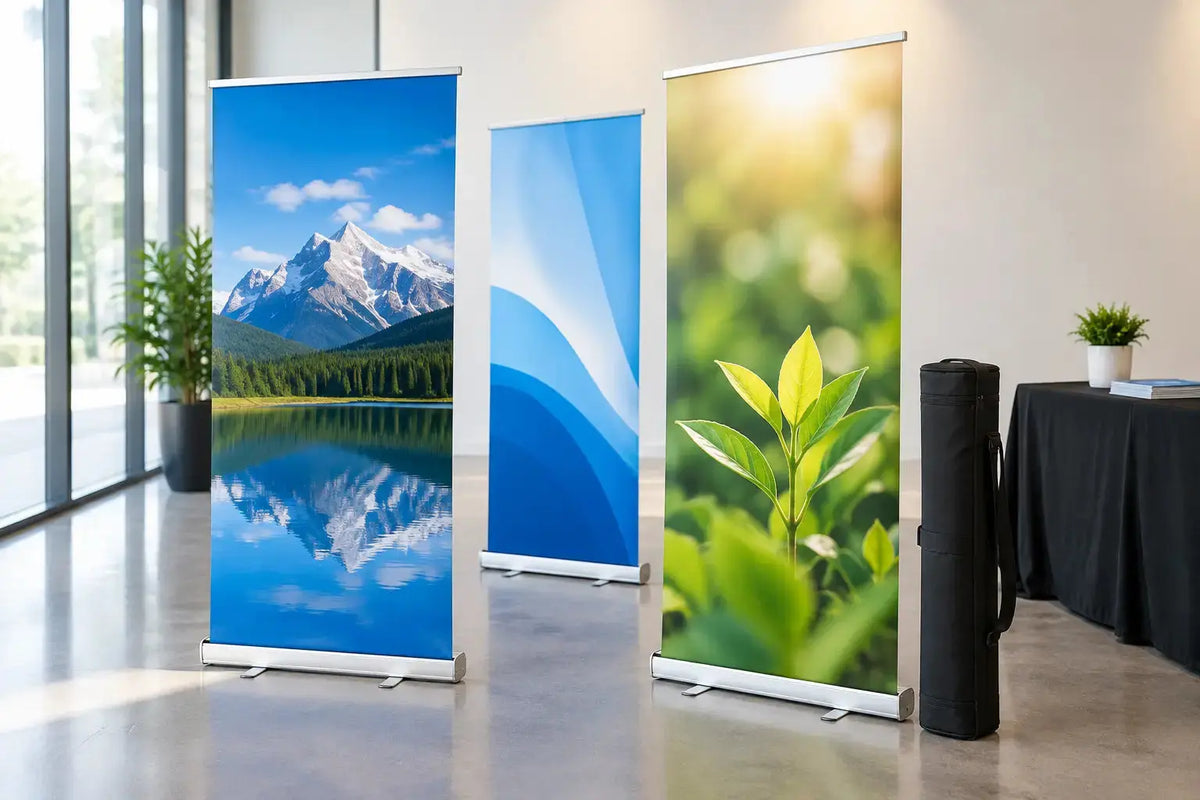
A busy exhibition floor gives your brand only a few seconds to be noticed. Portable banner stands put a clear message, product visual, or campaign offer at eye level without adding complicated installation, heavy equipment, or extra pressure to the event setup team. For businesses that attend trade shows, run retail promotions, host corporate events, or refresh office spaces, they are one of the most practical display formats available.
The right stand does more than hold a printed graphic. It needs to suit the location, travel requirements, viewing distance, and expected frequency of use. Selecting the correct size, base, and banner material helps your display look professional from the first setup through repeated campaigns.
Where Portable Banner Stands Deliver the Most Value
Portable banner stands work best when visibility needs to move with the campaign. A company may use the same display at a hotel conference in Dubai, a product launch in Abu Dhabi, and a client presentation the following week. Because the banner retracts or packs into a compact carry case, it can travel with an event team, sales representative, or marketing coordinator without requiring a full exhibition contractor.
They are especially effective at trade shows, conferences, malls, reception areas, retail entrances, showrooms, restaurants, training rooms, and temporary activations. In these settings, a banner stand can introduce a company, direct visitors, promote a seasonal offer, explain a service, or reinforce the visual identity already used across brochures, counters, uniforms, and signage.
For a short campaign, portability and quick setup may be the main priority. For a permanent showroom display, visual width, base stability, and print finish often matter more. This difference should guide the product selection from the beginning.
Choosing the Right Portable Banner Stand Type
The most suitable format depends on where the stand will be placed and how often it will be used. A standard roll-up banner is usually the most efficient choice for companies that need a compact, clean, and fast display. The printed panel pulls up from the base and connects to a support pole, allowing setup in minutes.
Roll-Up and Retractable Stands
Roll-up stands are a reliable option for exhibitions, meetings, receptions, and retail promotions. They are easy to transport, protect the graphic inside the base when packed away, and create a tidy presentation with minimal floor space. Standard widths suit many applications, while wider versions provide greater impact at busy events or behind product demonstration areas.
The trade-off is that a single roll-up banner is designed for a focused message. If you need to build a backdrop, present multiple service categories, or fill a wider booth area, several coordinated stands or a larger display system may be a better fit.
X-Banner Stands
X-banner stands use a lightweight frame that holds the corners of the printed graphic under tension. They are straightforward to carry and can be a practical choice for short-term campaigns, directional messages, and indoor promotions where the display will be moved frequently.
Because the graphic is visible to the edges, this style offers generous visual coverage for its footprint. However, the exposed frame creates a different appearance from a retractable base. It is best suited to campaigns where lightweight handling and flexibility are more important than a premium hardware finish.
L-Banner and Tension Stands
L-banner and tension-style displays are useful where a simple, open presentation is required. Their support structures are light, and replacement graphics can be practical for businesses that update offers, menus, campaign messaging, or event communications regularly.
These options can be cost-effective for repeated message changes, but they should be selected with the venue in mind. In high-traffic areas, a heavier base or a more substantial retractable system may provide better confidence and presentation.
Wide and Double-Sided Displays
Wider banner stands are valuable when visitors need to read your message from farther away. They work well as photo backdrops, booth back walls, stage-side branding, or large retail feature displays. Double-sided versions are useful in corridors, mall walkways, lobbies, and open event spaces where people approach from more than one direction.
More visual area is not always better. A wide display with too much text can become harder to understand at a glance. Use the additional space for a strong image, a concise headline, recognizable brand elements, and one clear action.
Size Should Match the Viewing Distance
Banner size is a commercial decision, not simply a design preference. A compact stand can perform well beside a registration desk or inside a meeting room, where people are standing close. A larger format is more appropriate for exhibition aisles, store entrances, or open venues where visitors first see the display from several meters away.
Before ordering, consider where the banner will sit, what may block it, and whether the audience will be seated, walking past, or waiting in line. A banner placed behind a counter may need extra height. One displayed next to a product shelf may need a narrower width to avoid obstructing access.
Keep the main message in the upper and center sections of the artwork. Lower areas can be partially hidden by furniture, bags, or passing foot traffic. Contact details, QR codes, and calls to action should remain large enough to read comfortably at the intended distance.
Print Material and Base Quality Matter
The visual quality of a banner stand comes from both the printed graphic and the hardware supporting it. A well-produced print should present brand colors, photography, typography, and key messaging clearly under typical indoor lighting. The material should also remain smooth when displayed, without distracting curl or excessive glare.
For frequent use, choose hardware built for repeated opening, packing, and transport. The base needs enough weight and balance to stand securely on a level indoor surface, while the pole and top rail should hold the graphic straight. Premium-style bases can improve the overall appearance for client-facing environments, exhibition booths, and branded reception areas.
If the stand will be used outdoors, assess the conditions carefully. Portable banner stands are generally most dependable indoors or in sheltered locations. Wind, uneven ground, and weather exposure can affect stability and print life. Where outdoor promotion is necessary, use a display solution designed for that environment rather than treating an indoor stand as an outdoor sign.
Create Artwork That Works at a Glance
A banner stand is not a brochure. Visitors should understand its purpose quickly, even while walking past. Start with one message: introduce a service, launch a product, announce an offer, or direct guests to a location. Trying to explain every capability on one panel usually reduces impact.
Use a strong headline, one relevant visual, and supporting information that earns a second look. Your logo should be visible, but it does not need to dominate the entire design. For service businesses, a clear benefit and a direct contact route often work better than a long list of services. For retail and food promotions, product photography, pricing where appropriate, and a concise offer can be more effective.
Maintain consistency with your existing marketing materials. The same colors, fonts, tone, and logo treatment used on packaging, brochures, counter cards, and office branding help customers recognize your business faster. This is particularly useful when several portable banner stands are placed across a larger event space.
Plan for Transport, Setup, and Reuse
The practical advantage of these displays is speed, but preparation still matters. Confirm that the carry case suits how the stand will travel and who will handle it. Event teams should know where the support pole is stored, how the graphic retracts, and how to pack the unit without forcing the mechanism.
For repeat use, store banner stands in a dry, clean location and keep the graphic retracted or protected when not on display. Avoid folding printed panels unless the specific system is designed for it. A quick check before every event can prevent last-minute issues with artwork, poles, or hardware.
When campaign messaging changes, decide whether a replacement graphic or a new display is the better operational choice. Reusing compatible hardware can be efficient for planned updates, while a new stand may make sense when moving to a different size, format, or presentation standard.
Order for the Actual Venue, Not Just the Artwork
A banner that looks good on screen still needs to perform on a real event floor. Share the intended use, location, desired size, artwork status, and delivery deadline when requesting a quote. This allows the supplier to recommend a portable banner stand that fits the setup rather than simply producing the first format requested.
Printava supports businesses that need display materials coordinated with exhibitions, promotions, office branding, and campaign launches. Get a quote today with your event requirements, and choose a banner stand that makes your message easy to see, easy to carry, and ready when your team arrives.