
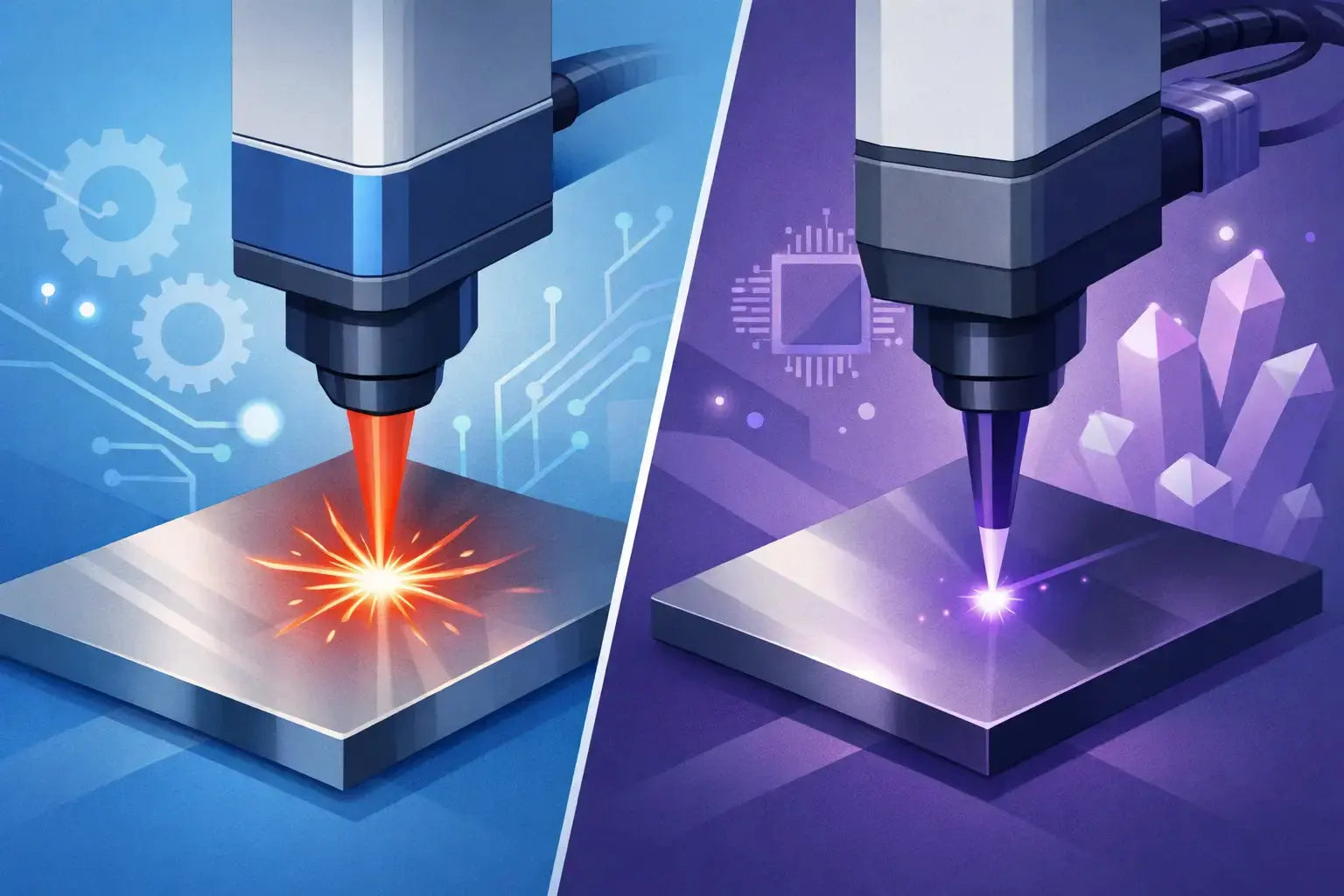
If you are comparing a fiber laser vs UV fiber laser, the wrong choice usually shows up later - burnt edges, weak contrast, damaged coatings, or a machine that is too slow for your order volume. For branding businesses, production teams, and buyers handling custom products, this is not a small technical detail. It affects finish quality, turnaround time, and margin on every job.
The short version is simple. A standard fiber laser is usually the better fit for fast, durable marking on metals and many rigid industrial materials. A UV laser is the better fit when the material is heat-sensitive, the marking area is small, or the finish must stay extremely clean and precise.
What changes between fiber laser and UV fiber laser
The biggest difference is how the beam interacts with the material. Fiber lasers typically use a longer wavelength and rely more on thermal energy. That makes them highly effective for engraving, annealing, and marking metals with speed and consistency. If your work includes stainless steel tags, aluminum items, coated metal gifts, tools, nameplates, or industrial parts, fiber laser systems are often the first machine considered.
UV lasers work differently. Their shorter wavelength creates what many operators call a colder marking process. That lower heat impact matters when you are working on plastics, films, glass, silicone, coated surfaces, and delicate branded products where scorching, melting, or edge damage would be unacceptable.
So while both machines can mark, they are not interchangeable in real production.
Fiber laser vs UV fiber laser for material compatibility
Material fit is where the decision gets clearer.
A fiber laser is the stronger choice for stainless steel, brass, aluminum, carbon steel, and many hard engineering plastics. It is widely used for serial numbers, logos, QR codes, barcodes, and permanent industrial identification. It also makes sense when you need production speed for bulk orders.
A UV laser is better when the substrate is sensitive or the surface finish matters more than raw speed. This includes clear or colored plastics, acrylic parts, medical-style components, cosmetic packaging, electronic housings, glass items, and some coated promotional products. On these materials, UV often produces sharper results with less charring and less stress on the product.
If your business handles mixed branding jobs, this matters. A machine that works well on metal keychains may not be the right option for plastic packaging components or delicate branded accessories.
Which one gives better marking quality
That depends on the result you need.
Fiber lasers are known for strong contrast and durable marks, especially on metal. For industrial branding, asset labeling, and long-life identification, they perform very well. They are also excellent when the mark needs to survive wear, handling, or outdoor use.
UV lasers are usually better for ultra-fine detail. Small text, intricate logos, dense QR codes, and precision marks on compact items tend to come out cleaner. If your customer expects a premium surface finish with minimal visible heat effect, UV has the advantage.
This is especially relevant for client-facing branded items. A rough or overheated mark can make the whole product feel lower value, even if the item itself is good.
Speed, cost, and production practicality
For many buyers, this is the deciding factor.
Fiber lasers are generally faster and more cost-effective for high-volume metal marking. If you are running repeated jobs on the same materials, they usually deliver better throughput and a lower cost per piece. That makes them a strong operational choice for workshops, manufacturers, and branding businesses handling regular bulk orders.
UV lasers are typically more specialized and often come with a higher upfront cost. They can also be slower depending on the application. But that extra cost can be justified when it prevents product damage, reduces rejects, and gives you access to materials a standard fiber laser may struggle to mark cleanly.
In other words, fiber often wins on speed and operating efficiency. UV often wins on versatility for sensitive materials and premium finish control.
When a fiber laser is the better business decision
Choose a fiber laser if most of your work is metal-based, the marks need to be permanent, and order volume matters. It is a practical fit for metal promotional products, industrial labels, machine parts, tools, branded plates, and asset tracking applications.
It is also the better first investment for many production environments because the use cases are broad and the output is fast. If your incoming jobs are predictable and material types are consistent, fiber gives you a reliable production workflow.
When a UV laser is worth the extra investment
Choose UV when your product range includes heat-sensitive materials, premium branded surfaces, or small detailed marking areas. It is a stronger option for high-value packaging, electronics branding, delicate plastic items, and products where appearance is just as important as permanence.
For businesses offering diverse custom branding, UV can reduce the risk of spoilage on difficult substrates. That matters when lead times are tight and rework is expensive. If you are also managing branded merchandise across different materials, it helps to standardize artwork correctly before production. Our guides on Best Logo File Formats for Printing and Print-Ready PDF Requirements That Avoid Reprints can help reduce setup issues before the job reaches the machine.
The right choice depends on your order mix
If your core workload is metal marking at scale, fiber laser is usually the smarter and more economical option. If your jobs regularly involve delicate plastics, coated items, or highly detailed branding where heat damage is a risk, UV is often the safer choice.
For many commercial print and branding businesses, the real question is not which technology is better overall. It is which one matches the products you sell, the finish your customers expect, and the turnaround you need to maintain. If your business is expanding into customized gifts, event items, or mixed-material branding, choosing the right laser setup can protect both quality and delivery commitments.
That is the kind of decision worth getting right before the next bulk order lands.