
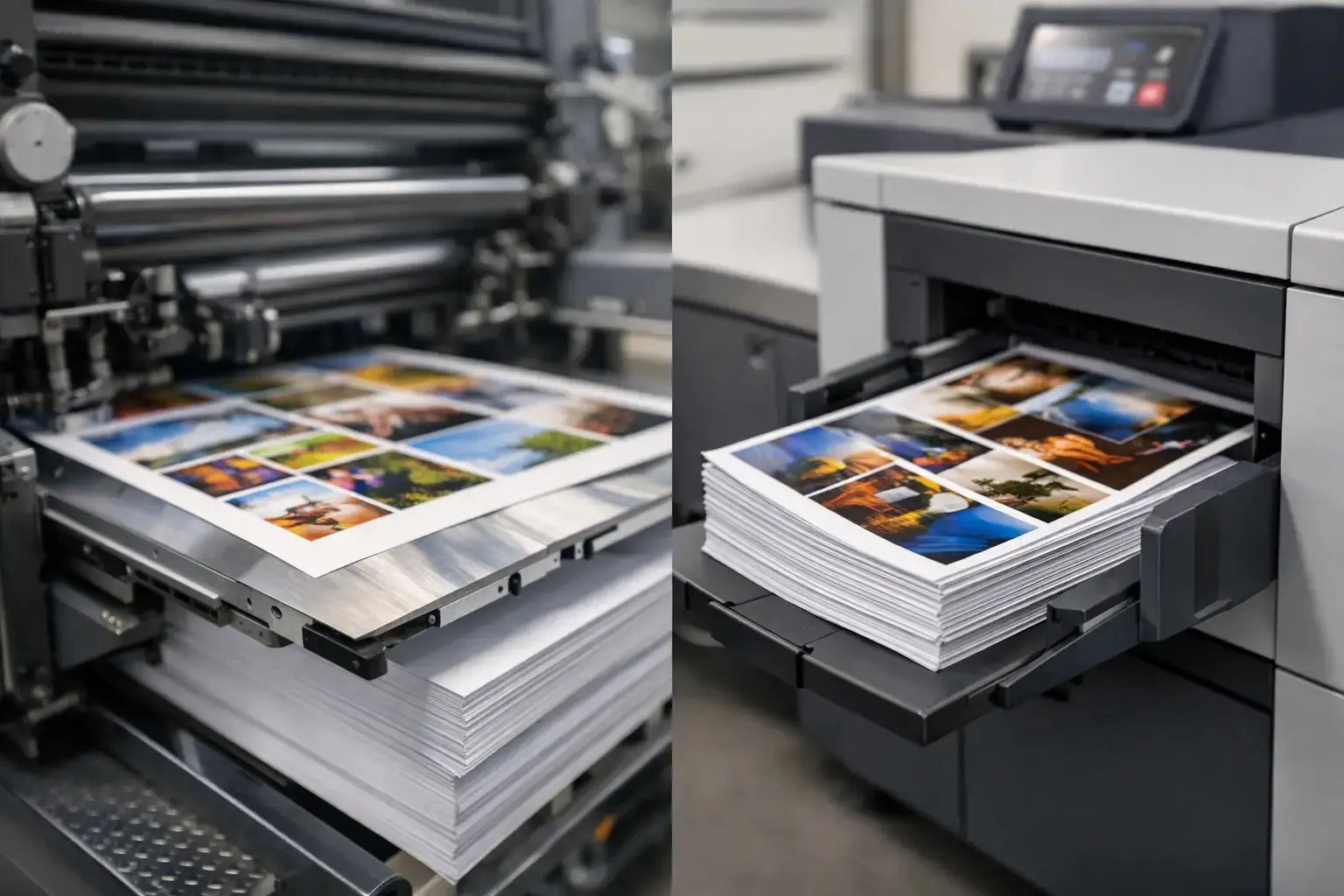
A short-run flyer order for a product launch and a 20,000-piece brochure run for a retail campaign should not be handled the same way. That is where offset printing vs digital becomes a practical business decision, not just a technical one. The right choice affects lead time, consistency, unit cost, versioning, and how your brand appears in the hands of customers.
For procurement teams, marketers, and business owners, the question is usually not which method is better overall. It is which one fits the job in front of you. If you are printing event handouts, restaurant menus, branded inserts, product catalogs, labels, or corporate stationery, the decision depends on volume, timeline, material, and how precise the final result needs to be.
Offset printing vs digital: the core difference
Offset printing uses metal plates and rubber blankets to transfer ink onto paper or other substrates. It is a traditional commercial printing method built for consistency and scale. Because it requires setup before production starts, it makes the most sense when you need higher quantities and a stable design across the full run.
Digital printing applies artwork directly from a digital file to the material without plates. That reduces setup time and makes it ideal for shorter runs, urgent orders, and projects where content may change from one piece to the next. If you need 100 brochures today with a fast approval cycle, digital is often the practical route.
At a glance, offset favors volume and exact repeatability, while digital favors speed and flexibility. But most real-world jobs sit somewhere in between, which is why the details matter.
When offset printing is the better choice
Offset printing works best when quantity is high enough to justify setup and when visual consistency is a priority. Once the press is running, the cost per piece becomes very efficient. For businesses ordering large batches of catalogs, flyers, folders, packaging sleeves, or branded inserts, that cost advantage can become significant.
Color control is another reason companies choose offset. Brand-sensitive work often benefits from the precision of press calibration and the ability to match specific ink requirements. If your print job includes strict corporate colors, especially across a long campaign or multiple batches, offset gives you strong control over consistency.
It also performs well on a wide range of paper stocks and finishing requirements. That matters for premium marketing pieces, presentation folders, and printed materials where feel and finish support the brand message. In sectors where printed presentation still carries weight, such as hospitality, real estate, retail, and corporate sales, offset often earns its place.
The trade-off is time. Plate creation, setup, and press preparation mean offset is not always the first choice for last-minute printing. It rewards planning.
Best use cases for offset
Offset is usually the stronger option for high-volume brochures, annual reports, branded stationery runs, product sheets, magazine-style booklets, packaging components, and marketing collateral with stable artwork. It is also a good fit when multiple departments need the same printed item in bulk over time.
When digital printing makes more sense
Digital printing is built for speed, lower quantities, and adaptability. If your team needs materials for an event next week, a sales pitch tomorrow, or a new campaign with final artwork still changing, digital keeps the process moving.
It is especially useful when quantities are modest. Short runs avoid the upfront setup cost of offset, so ordering only what you need becomes more practical. That can reduce waste for seasonal promotions, temporary offers, test campaigns, and event-specific materials.
Another major advantage is variable data. Digital printing can change names, codes, branches, offers, or regional details from one piece to the next without stopping production. For personalized direct mail, ticketing, customized labels, or campaign segmentation, offset simply is not the efficient choice.
Digital also works well when businesses want to print in phases. Instead of committing to one large run, you can order smaller batches as inventory, messaging, or campaign timing changes. For growing companies and fast-moving teams, that flexibility has real value.
Best use cases for digital
Digital is ideal for short-run flyers, event materials, training manuals, business cards, presentation packs, small-batch stickers, promotional inserts, personalized marketing pieces, and quick-turn branded materials where speed matters as much as finish.
Cost: setup vs unit price
Cost is where many printing decisions are made, but it needs to be viewed correctly. Offset printing usually has a higher upfront setup cost because plates and press preparation are involved. That makes small runs less economical. Once quantities rise, however, the unit price drops and offset often becomes more cost-effective overall.
Digital printing has a lower barrier to entry. There is less setup, so small and medium runs are usually more affordable. If you only need a few hundred pieces, digital may give you the best balance of budget and turnaround.
The important point is this: the cheapest method depends on quantity. A low-volume order and a high-volume order follow different logic. Buyers who compare only the total quote, without considering unit economics and reprint frequency, can easily choose the wrong method.
Quality and color expectations
Both methods can produce strong commercial results, but they behave differently. Offset is known for sharp detail, smooth color transitions, and excellent consistency across large runs. It is often preferred for premium printed assets where exact brand presentation is essential.
Digital printing has improved significantly and delivers very professional results for most business uses. For many flyers, sales sheets, menus, and branded handouts, digital quality is more than sufficient. In fact, for quick campaigns and short-run marketing material, the speed-to-output benefit often outweighs any minor technical differences.
Where quality discussions become more specific is with solid color areas, exact brand matching, special inks, and long-run consistency. If your stakeholders are highly particular about repeat color performance across thousands of pieces, offset deserves close consideration.
Turnaround and operational flexibility
If speed is the first priority, digital usually wins. Files can move from approval to production quickly, which helps businesses respond to events, launches, and internal requests without delay. For urgent corporate printing, digital helps teams stay agile.
Offset is better treated as a scheduled production method. It is efficient when the job is planned properly, artwork is finalized, and quantities justify the process. For recurring print programs, this can work very well. For reactive or fast-changing requirements, it can be less convenient.
This is why many companies use both methods depending on the campaign stage. They may print a short digital batch first for review, early distribution, or launch testing, then shift to offset for full-scale rollout once details are locked.
How to choose the right print method
Start with quantity. If the run is large and the design is fixed, offset is often the better commercial decision. If the run is small or still evolving, digital is typically the more efficient path.
Then look at timing. If you need materials quickly, digital offers speed with minimal setup. If you have lead time and want the best long-run unit cost, offset becomes more attractive.
Next, consider the role of the printed piece. A premium product catalog, investor presentation folder, or large brochure campaign may justify offset. Event leaflets, internal booklets, branch-specific promotions, or versioned marketing pieces usually lean digital.
Finally, think about change. If names, offers, locations, or quantities might shift, digital gives you control without forcing a full reprint strategy. That matters for businesses managing multiple outlets, seasonal activations, or segmented campaigns across the UAE.
A practical business view of offset printing vs digital
The best print buying decisions are rarely based on theory. They come from matching the method to the outcome you need - speed, scale, consistency, flexibility, or a combination of all four. A reliable print partner should help you weigh those factors before production starts, not after a file is already on press.
At Printava, that usually means asking the right questions early: how many pieces are needed, how quickly they are required, whether the artwork will stay fixed, what material is being used, and how the printed item will be distributed. Those details shape the right recommendation.
If you are choosing between offset and digital for your next print job, treat it like any other procurement decision. Look at use case, timing, quantity, and brand requirements together. The smartest print method is the one that supports the campaign, avoids unnecessary cost, and gets the job done right the first time. Get a quote today and start with the method that fits your business, not just the file.