
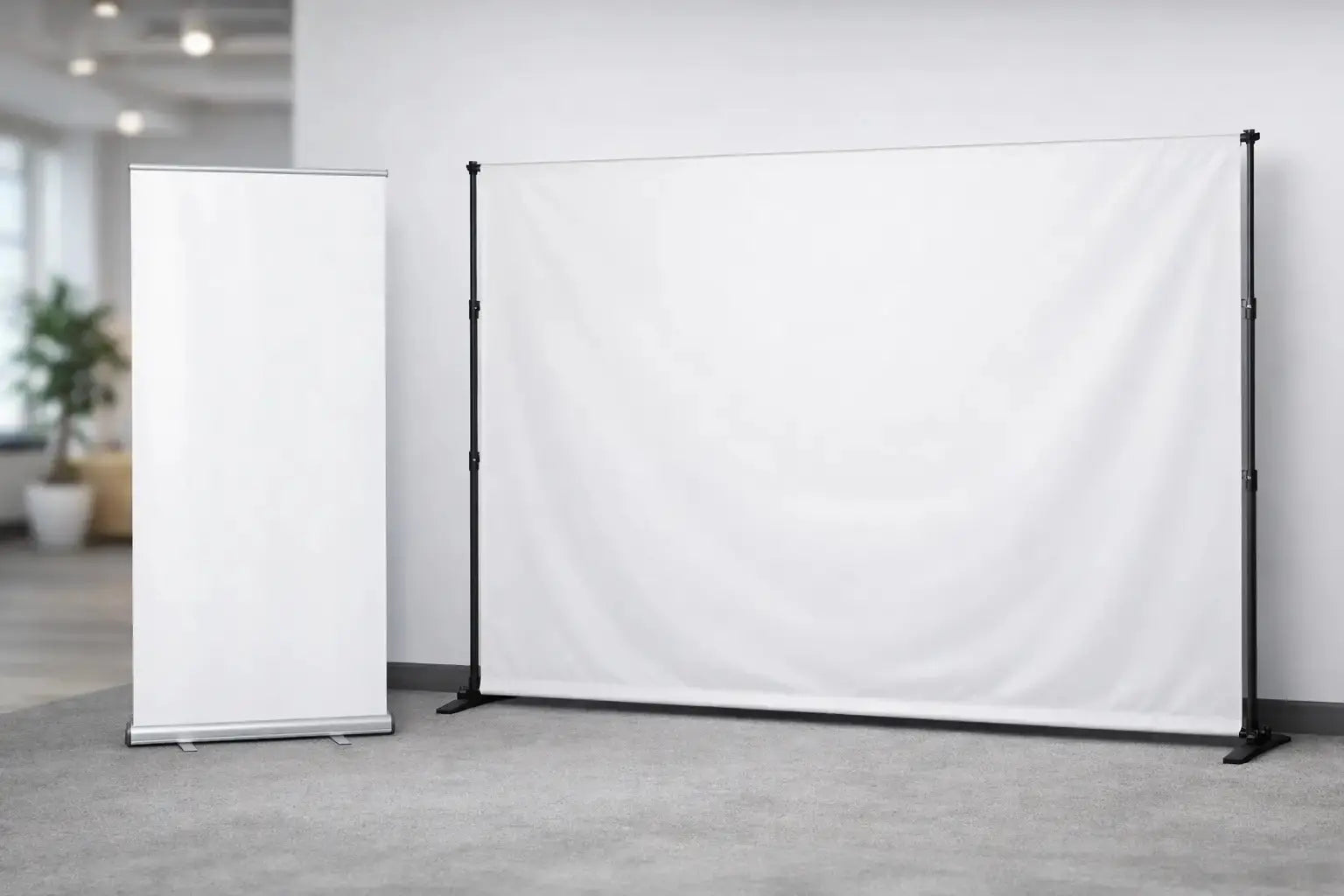
At a trade show booth, reception area, or product launch, the wrong display can make a strong brand look unprepared. When comparing roll up banner vs backdrop options, the real question is not which one looks better in isolation. It is which one fits your space, message, setup time, and event goal without creating avoidable issues on the day.
Both formats are widely used because both work. But they do different jobs. If you are ordering for a corporate event, exhibition stand, in-store promotion, media wall, or office branding project, choosing the right format early will save time, control cost, and give your team a cleaner final result.
Roll up banner vs backdrop: the core difference
A roll up banner is a vertical, retractable display that stands on its own base and packs into a carry bag. It is designed for portability, fast setup, and compact messaging. Most businesses use it for directional branding, product highlights, promotions, reception branding, and event support where floor space is limited.
A backdrop is a larger display panel or tension-fabric-style background built to cover more visual area. It is commonly used for step-and-repeat branding, stage backgrounds, photo walls, press events, exhibition spaces, and presentation areas where visibility from a wider distance matters.
The simplest way to think about it is this: a roll up banner communicates one focused message in a narrow footprint, while a backdrop creates an environment. If your team needs a practical sign that can move from one location to another, the banner often makes more sense. If you need a branded background that anchors a space, the backdrop usually does the heavier lifting.
When a roll up banner is the smarter choice
Roll up banners work best when speed and flexibility matter. They are easy to transport, fast to assemble, and practical for teams that attend multiple events or need displays across different branches, meeting rooms, or activation points.
They also suit businesses that need targeted messaging. A roll up banner can introduce a service, highlight a promotion, display a QR code, or support a sales conversation without overwhelming the area. In retail and event settings, that focused visibility is often more useful than a large graphic wall.
Another advantage is placement. Because the footprint is narrow, a roll up banner fits reception desks, mall activations, conference entrances, waiting areas, and booth corners. If your venue has limited space or strict layout constraints, this format is easier to accommodate.
There is a trade-off. A roll up banner does not create the same visual impact as a full-size backdrop. It is excellent for supporting branding, but it rarely becomes the centerpiece unless used as part of a group. If the objective is to dominate a stage area or create a photo-friendly branded background, one banner will usually not be enough.
Best use cases for roll up banners
This format is ideal for sales presentations, conference registration areas, product launches, school and university events, retail promotions, clinic receptions, real estate displays, and office lobbies. It is also a strong option when procurement teams need several branded units for multiple locations with consistent artwork and easy storage.
When a backdrop is the better investment
A backdrop is built for presence. It fills space, frames people, and makes branding visible in photographs, videos, and live event settings. If your event includes media coverage, guest photography, presentations, or a designated branded zone, a backdrop often delivers more value than several smaller displays.
It also helps when the design needs room to breathe. Logos, campaign visuals, sponsor branding, product imagery, and large-format messaging tend to look more polished on a wider surface. The result feels intentional rather than added at the last minute.
For exhibitions, backdrops can define the stand itself. Instead of placing branding around the booth, the booth becomes the branding. That makes a difference when foot traffic is high and attention is limited.
The trade-off is practicality. Backdrops need more setup space, and depending on the frame system, they may require more planning for transport and installation. They are not difficult to use, but they are less convenient than pulling up a banner and placing it in position. If your team moves often between venues or needs a quick setup before each meeting, a backdrop may feel less efficient.
Best use cases for backdrops
Backdrops are well suited for exhibitions, red carpet or press events, corporate stage branding, brand activations, sponsorship walls, panel discussions, award ceremonies, and photo booths. They also work well in permanent or semi-permanent branded spaces where a stronger visual statement is needed.
Size, viewing distance, and message clarity
One of the most common buying mistakes is choosing based on product type before considering viewing distance. A roll up banner is usually read at close range. People stand beside it, walk past it, or approach it during a conversation. That means the message should be short, the logo clear, and the hierarchy easy to read in seconds.
A backdrop is often viewed from farther away. It needs larger branding, cleaner composition, and enough spacing to avoid visual clutter. If you try to place too much detail onto a backdrop, the design may technically fit but still fail in the venue.
This matters because the same artwork rarely works equally well on both formats. A banner can support detailed service information or a call to action. A backdrop should usually focus on brand identity, campaign theme, or repeat logo placement for visibility in photos.
Portability and setup time
If your team is managing events across multiple locations, portability matters as much as print quality. Roll up banners are easier to store, transport, and deploy. A single staff member can usually carry and assemble one in minutes. That makes them attractive for recurring roadshows, in-store campaigns, and mobile marketing setups.
Backdrops vary more depending on the system. Some are straightforward and efficient, while others require larger packaging, more assembly time, or additional coordination on-site. That does not make them a poor choice. It simply means they are better suited to spaces where branding impact justifies the extra setup.
For many businesses, the decision comes down to event rhythm. If you attend frequent short-duration events, roll up banners often give better operational value. If you invest in fewer, higher-visibility events where presentation matters more, backdrops may produce stronger returns.
Budget value is not just the unit price
Procurement teams often start with cost per unit, but display value should be measured against usage. A roll up banner is generally more cost-efficient for frequent transport and repeated deployment in smaller spaces. You can order several with different messages and use them across departments or campaigns.
A backdrop can cost more depending on size, structure, and print system, but it may deliver better value when the objective is brand presence at flagship events. If one backdrop becomes the main visual asset across press photos, interviews, presentations, and social media coverage, the return can justify the larger investment.
This is why roll up banner vs backdrop is not really a question of cheap versus expensive. It is a question of fit. The wrong product at the right price still underperforms.
How to decide quickly
If you need a display for a lobby, a sales pitch, a registration desk, or a compact exhibition space, start with a roll up banner. If you need a branded wall for photography, staging, or a wider booth environment, start with a backdrop.
If your event includes both foot traffic and photography, using both can be the strongest option. A backdrop can anchor the main space, while roll up banners guide visitors, promote offers, or reinforce product messaging around the perimeter. For many business events, this combination creates a more complete branded setup than relying on one format alone.
It also helps to ask three practical questions before ordering. How much floor space is available? Will people read the display up close or see it from a distance? Does the display need to travel often? Those answers usually point clearly to the right format.
For companies ordering in Dubai and across the UAE, this decision often comes down to execution speed and event format. A polished display is not only about artwork. It is about choosing a structure that fits the venue, the logistics, and the message from the start.
If you are still deciding between the two, do not start with what looked good at someone else’s event. Start with what your team needs the display to do, then print for that purpose. Get a quote today and choose the format that will work just as well on-site as it does in the artwork proof.