
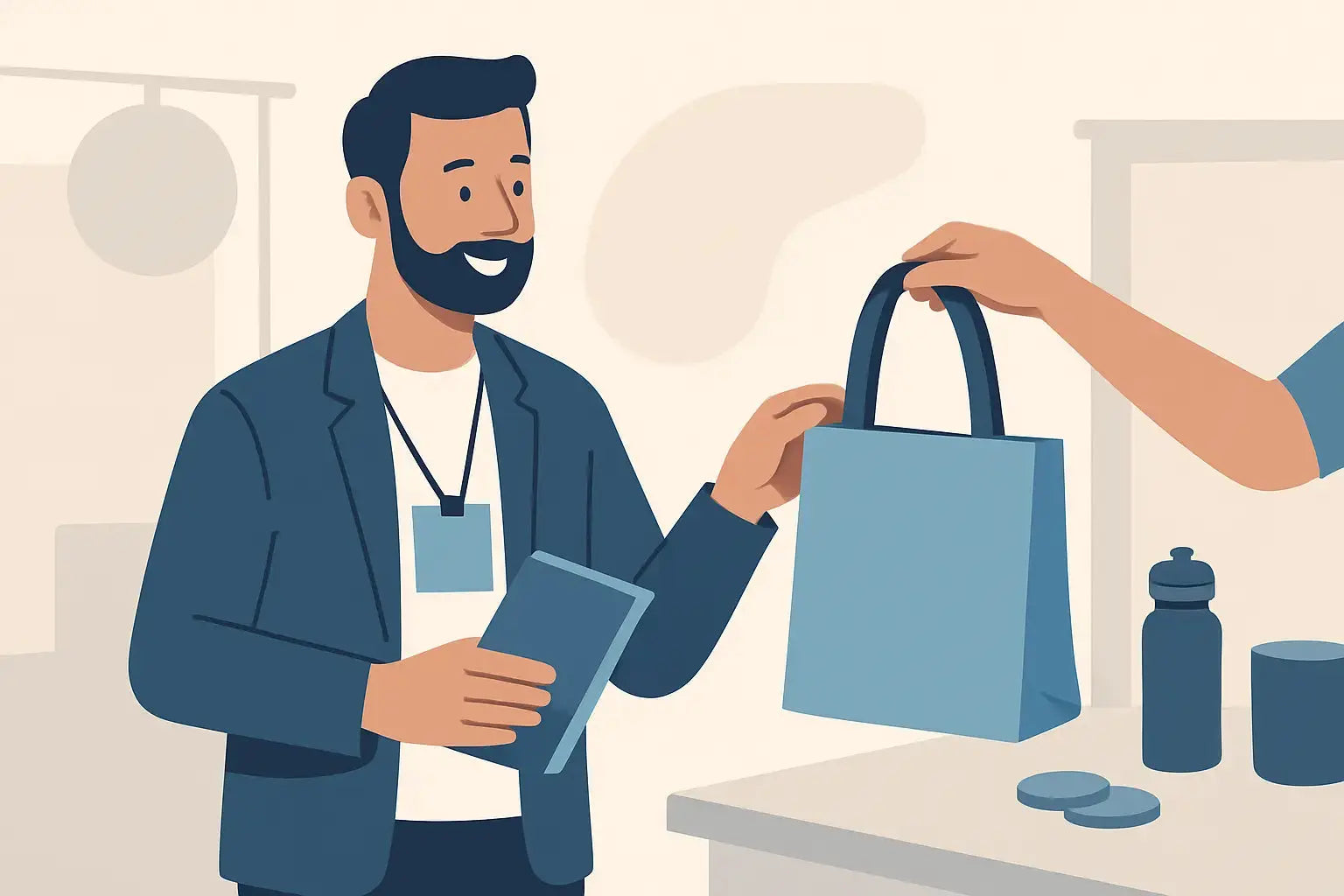
You can tell within the first hour if your trade show giveaways are working.
If your booth team is constantly interrupted with quick, low-friction conversations, your promotional items are doing their job. If people walk by, glance, and keep moving, it usually is not your product - it is your offer. Promotional items for trade shows are not about being generous. They are about earning attention fast, creating a reason to stop, and putting your brand in someone’s hands long enough for your pitch to land.
The buyers you want are also the most distracted. They are on tight schedules, carrying too much, and fielding “Can I scan your badge?” every few steps. Your job is to make the next step easy: stop, smile, engage, leave with something worth keeping.
What “good” looks like for promotional items for trade shows
A giveaway performs when it accomplishes at least one of these outcomes - and ideally two.First, it increases booth traffic with a clear, immediate benefit. Second, it improves lead quality by giving you a reason to ask one qualifying question. Third, it extends brand recall after the show because the item stays on a desk, in a bag, or in a daily routine.
That last one is the most expensive to win and the most profitable. If your giveaway becomes part of someone’s workflow (charging, note-taking, coffee, travel), your brand gets repeated impressions without paying for a second touch.
Start with the constraints: baggage, climate, and show rules
Trade show floors are not equal. What works at a tech expo can flop at a healthcare conference. Before you choose products, decide what you can realistically deliver.If attendees are flying, weight and bulk matter. A premium metal bottle might look impressive, but if it feels heavy in a tote after three halls, it gets left behind. In many venues, liquids, open food, and certain batteries may trigger restrictions. For outdoor or high-traffic events, durability and print longevity matter more than delicate finishes.
In the UAE, you also plan for heat, but even for US readers, the same principle applies: climate changes usage. Items that live in a car (sunshades, insulated tumblers) perform differently than items intended for office desktops.
The highest-ROI categories (and when they win)
There is no single “best” giveaway. The right choice depends on your booth goal and your buyer.Everyday carry: the fastest path to retention
If you sell B2B services, software, logistics, construction, or anything with a longer sales cycle, you want your brand to stick around. Everyday carry items win because they travel.Think premium pens, slim notebooks, card holders, cable organizers, and keychain tools. The trade-off is that these categories are crowded. You only stand out if the item feels noticeably better than the average freebie - smoother writing, better packaging, cleaner print, or a more refined color palette.
A good pen is not a cheap pen with your logo. It is a pen someone prefers using.
Desk and office: high visibility after the show
Desk items are quiet performers because they create repeated exposure. Sticky notes, desk calendars, mouse pads, and magnetic planners can generate more impressions than “cooler” items that get used once.The catch is design. Desk items look cheap when the layout is crowded or the print is off. Keep the branding clear, give the design space, and use finishes that resist smudging.
If you serve operations, procurement, HR, or facility teams, desk items also match the buyer’s environment. You are not forcing a lifestyle product into an office reality.
Drinkware: perceived value, but heavier logistics
Tumblers, mugs, and insulated bottles feel premium and can justify a higher-quality lead capture process. They also photograph well at the booth, which can help if you are running social content during the show.The trade-offs are shipping weight, storage space, and the reality that not everyone wants to carry drinkware around a venue. If you choose this category, keep quantities planned and have a clear distribution rule - for example, “book a demo” or “meet with our team.”
Tote bags: the giveaway that markets itself
Tote bags are not subtle, and that is why they work. When attendees carry your bag, your logo moves across the venue all day.But totes are also the easiest item to get wrong. Thin material, weak stitching, or a design that looks like an ad will reduce usage. Choose a bag that holds weight, has comfortable handles, and looks clean enough to reuse.
If you want one item that supports booth traffic and gives people a practical reason to engage, totes are a safe bet - as long as quality is there.
Tech accessories: strong appeal, higher expectations
Phone stands, charging cables, power banks, webcam covers, and screen cleaners perform well in tech-heavy shows. They also create a natural opening line: “Do you need a charger?”The downside is that expectations are high. If the cable feels flimsy or the print rubs off, your brand takes the hit. Power banks require more compliance and careful sourcing. If your brand reputation matters, do not gamble on the lowest-cost tech option.
Match the item to the moment in your funnel
The biggest mistake is giving the same thing to everyone.Use a two-tier approach. Keep a “traffic” item for quick handoffs to build flow at the booth, then reserve a “value” item for qualified conversations.
A traffic item might be a premium pen, badge holder, small notebook, or screen wipe. It is fast to distribute and does not require storage headaches.
A value item might be a tumbler, higher-end notebook, tech accessory kit, or a curated gift set. This is what you trade for a meeting, a demo, a proposal request, or a serious conversation with a decision-maker.
This structure also protects your budget. You are not overspending to impress people who were never going to buy.
Branding that looks premium (even on a tight timeline)
Print quality is not a detail at a trade show. It is the first proof of your operational standards.If your logo is complex, choose products and print methods that keep edges crisp. If you are printing on fabric, consider how the color will look under bright exhibition lighting. If the item is handled constantly, choose finishes that resist scratching and fading.
Good branding is also restraint. One strong logo placement, one brand color, and a clean layout typically outperform a front-and-back design filled with phone numbers, taglines, and QR codes. If you want a QR code, place it where it will actually be scanned - on packaging, on a thank-you card, or on a small insert that explains the offer.
Don’t forget the “supporting cast” that makes giveaways work
Giveaways alone do not create leads. The booth system does.If you are offering promotional items for trade shows, make sure the booth is ready to distribute them efficiently. That means clear signage, quick talking points, and enough printed collateral to continue the conversation.
A well-designed counter card explaining “what you get” and “how to qualify” can prevent your team from repeating the same script all day. Business cards still matter for certain industries, but a simple one-page flyer or mini-brochure often performs better because it carries benefits, use cases, and a clear next step.
If you want attendees to remember you, consider packaging. A giveaway placed in a branded pouch or small box instantly feels more valuable than the same item handed over loose.
Quantity planning: avoid running out or hauling leftovers
Order sizing is a practical decision, not a guess.Start with expected foot traffic, then decide what percentage you want to convert into a conversation. Your traffic item should cover that number with a buffer. Your value item should be sized to your realistic target for qualified leads, not your wishful thinking.
If your booth is small and storage is limited, choose slimmer items and replenish daily. If you are shipping to the venue, build in time for delays and consider sending items in labeled cartons by category so your team can restock without digging.
Speed and execution: why timelines change what you should choose
Trade shows create deadline pressure. If you have two weeks, you do not pick the same products you would pick with six weeks.Short timelines favor items with stable stock, straightforward printing, and minimal assembly. Complex gift sets, custom-molded items, and multi-location printing can be worth it, but only when there is time for sampling and approvals.
If you need a single supplier that can handle both the giveaways and the exhibition essentials (brochures, banners, backdrops, counters), it reduces risk. Businesses working against a show deadline often use a vendor like Printava Advertising Requisites Trading L.L.C because you can quote quickly, upload artwork files, and move multiple branded outputs into production without juggling separate timelines.
A practical decision filter you can use today
When you are choosing between two items that seem equally good, use this filter.Will the attendee carry it easily for the rest of the day? Will it be used at least weekly? Does it look and feel consistent with how you want your brand perceived? Can your team distribute it without slowing down conversations? If you answer “no” to two or more, keep shopping.
The best giveaway is the one that fits the audience, the event, and your operational reality. If it creates smooth booth interactions and stays in someone’s routine after the show, it is not a cost line item anymore. It is a sales tool that keeps working long after the hall lights shut off.