
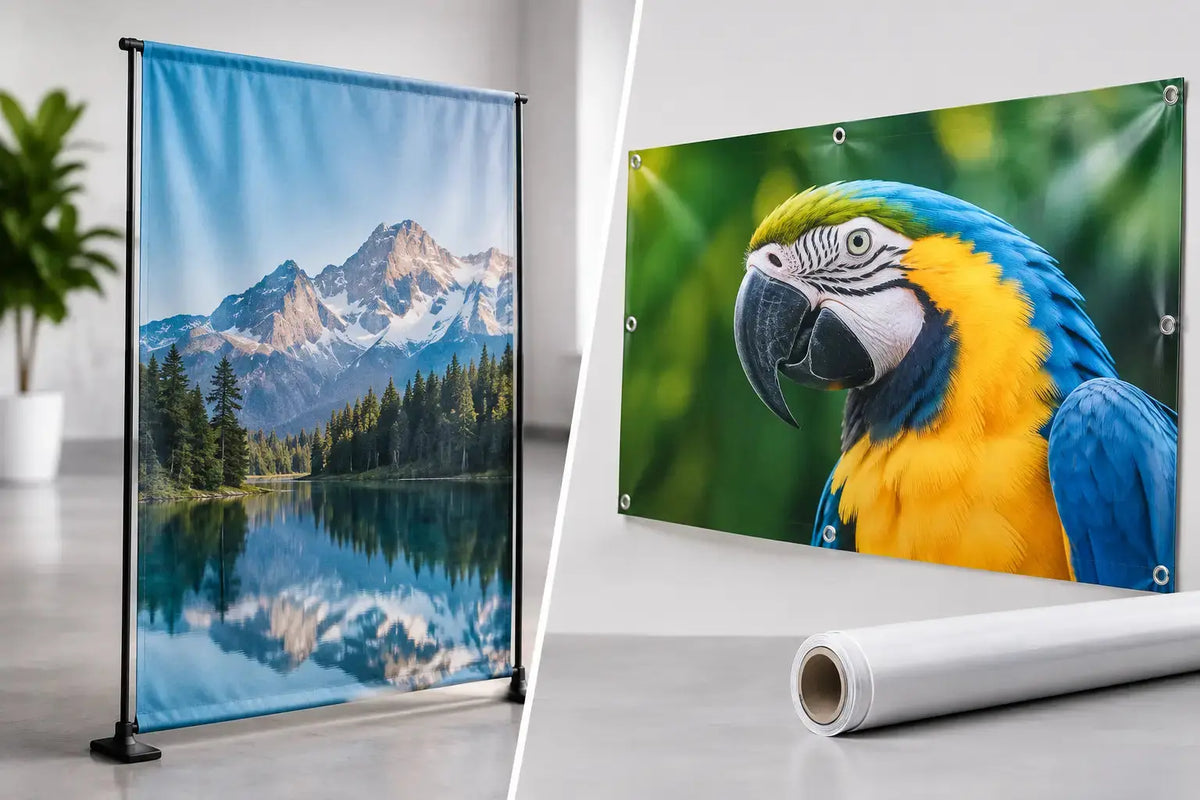
A fabric banner versus PVC banner decision often comes down to one practical question: where will the display be used, and how often will it move? A premium exhibition booth, a retail promotion, a construction-site message, and a long-term outdoor sign all place very different demands on printed materials. Choosing the right banner helps protect brand presentation, simplify setup, and avoid ordering a material that is not suited to the environment.
For UAE businesses planning events, campaigns, store launches, office branding, or outdoor promotions, fabric and PVC each have a clear role. The best option is not always the most durable or the lightest. It is the one that supports the display location, installation method, visual standard, and campaign timeline.
Fabric Banner Versus PVC Banner: Key Differences
Fabric banners are typically made from polyester-based textile materials and printed using methods designed to produce rich, integrated color. The surface has a soft, matte appearance that reduces glare under exhibition lighting, office lighting, and photography. Depending on the application, fabric can be supplied for tension frames, hanging banners, backdrops, pop-up displays, and indoor promotional graphics.
PVC banners are vinyl-based display materials built for strength and practical outdoor performance. They are commonly used for storefront messaging, building wraps, outdoor promotions, site signage, fence banners, directional displays, and campaign graphics. PVC provides a smooth printable surface and can be finished with hems, eyelets, pole pockets, or other installation details based on the display requirement.
The most visible difference is the finish. Fabric generally looks more refined and presentation-led, while PVC looks more structured and utility-led. That does not make one better than the other. It makes each more appropriate for different business settings.
When Fabric Is the Better Choice
Fabric banners work especially well when appearance, portability, and indoor presentation matter most. They are a strong choice for exhibition stands, conference backdrops, product launches, corporate events, mall activations, media walls, and branded office interiors. Their matte finish can help logos, photography, and brand colors remain clear under spotlights and camera flashes.
For marketing teams managing repeated events, fabric can also be easier to transport. Many fabric graphics fold down compactly, reducing the bulk associated with rigid signage or rolled vinyl. This is useful for businesses that send displays between branches, event venues, and sales meetings.
Fabric is often the preferred option for tension-frame systems because the material sits taut across the frame, creating a clean edge-to-edge visual. The result can feel closer to a branded wall than a conventional banner. For customer-facing environments where visitors will stand close to the display, this finished look matters.
There are trade-offs. Fabric is not usually the first choice for long-term exposure to harsh weather, frequent contact with dirty surfaces, or locations where the banner may be subject to heavy abrasion. It may also require more considered handling during installation to keep the graphic smooth and properly tensioned. For a short indoor campaign or a polished event environment, these considerations are usually manageable. For an exposed roadside or construction application, PVC is often more practical.
Best fabric banner applications
Fabric is particularly suitable for exhibition backdrops, stretch display walls, indoor hanging banners, branded photo backdrops, conference graphics, retail launch displays, and reusable event kits. It is also a good fit when a business wants a premium, low-glare visual for photography and video.
When PVC Is the Better Choice
PVC banners are designed for visibility and resilience in demanding environments. They are commonly selected for outdoor advertisements, building-front messaging, restaurant promotions, retail sale banners, directional signage, property campaigns, and event perimeter graphics. With the right finishing and installation, PVC can handle larger formats and more exposed locations effectively.
For businesses that need a banner secured to fences, walls, frames, or temporary outdoor structures, PVC offers dependable flexibility. Eyelets and reinforced edges can support secure mounting, while the material remains easy to clean and maintain during the campaign. It is also well suited to large-format messages that need to be read from a distance.
PVC is a practical choice when weather exposure is part of the brief. Sun, dust, humidity, and wind all affect display materials differently, so banner placement should be reviewed before production. A banner installed outdoors needs more than an attractive design. It needs suitable material weight, reinforcement, mounting points, and sizing for the installation surface.
The trade-off is that PVC can be heavier and less compact than fabric, particularly at larger sizes. Its surface may also show more glare under strong indoor lighting. If the banner will serve as a close-up corporate backdrop at a premium event, fabric may produce the stronger visual result. If it will hang across an outdoor façade for a seasonal promotion, PVC is usually the more suitable working material.
Best PVC banner applications
PVC is well suited to outdoor promotional banners, storefront campaigns, fence displays, construction-site signage, large retail announcements, directional graphics, sponsor banners, and temporary event signage. It is often the practical answer when durability and installation flexibility take priority.
Compare Print Finish, Color, and Visibility
Both materials can support professional branded graphics, but the viewing environment changes how they perform. Fabric’s matte texture helps minimize reflections, making it a reliable option for indoor spaces with direct lighting. It can give solid colors, gradients, and photographic designs a softer, more premium appearance.
PVC has a smoother surface that can make bold colors and large text highly visible from a distance. This is useful for promotional messaging that must be noticed quickly from a road, walkway, or retail entrance. For outdoor banners, strong contrast and clear typography often matter more than fine design detail.
Design should follow the material and placement. A close-viewed fabric backdrop can carry more refined imagery and smaller brand elements. A PVC banner facing passing traffic should use concise copy, large type, high contrast, and a clear call to action. The material decision and artwork setup should be planned together, not treated as separate steps.
Installation and Setup Considerations
Installation details can determine whether a banner looks professional after it is printed. Fabric graphics may use silicone edge beading for tension frames, stitched pockets for poles, or lightweight hanging systems. These formats are ideal for controlled indoor installations where alignment and presentation are priorities.
PVC banners are commonly finished with eyelets, hems, reinforced corners, or pole pockets. The right choice depends on whether the banner will be tied to a fence, fixed to a wall, suspended from a frame, or mounted across an opening. Large banners may need additional fixing points to distribute tension evenly and help prevent sagging.
Before requesting a quote, confirm the final width and height, installation location, viewing distance, orientation, finishing requirement, and whether the banner will be used indoors or outdoors. These details allow the production team to recommend a material and finishing method that fits the job from the start.
Cost Should Be Evaluated by Use, Not Just Size
Banner pricing varies based on material, dimensions, print coverage, finishing, quantity, and installation requirements. Comparing only the cost per square foot can lead to the wrong purchase decision. A low-cost material that needs to be replaced quickly or does not suit the venue is rarely the most efficient option.
Fabric can be a better investment for reusable exhibition graphics and corporate displays where presentation is a priority. PVC can offer stronger value for short-to-medium-term outdoor promotions, oversized messaging, and campaigns that require a tougher material. The right comparison is total usefulness across the intended campaign, not simply the first production cost.
For recurring promotions, consider whether the graphic will be reused, stored, moved between locations, or updated regularly. A retail chain might choose PVC for storefront sale campaigns and fabric for internal launch events. A company exhibiting at trade shows may use fabric backdrops for its stand while using PVC directional banners outside the venue. Many businesses benefit from using both materials in the same campaign.
How to Make the Right Banner Decision
Choose fabric when the display is primarily indoors, needs a premium matte finish, will be photographed, or must pack down for repeated events. Choose PVC when the banner will be outdoors, requires secure eyelet-based installation, needs to cover a large area, or will face more demanding conditions.
If the application sits between these categories, ask for guidance based on the actual installation. A banner in a covered outdoor mall, for example, may need a different solution than one on an open roadside. Likewise, a short indoor retail promotion may not require the same finish as a permanent reception-area display.
Printava can help businesses assess material, size, finishing, artwork setup, and delivery requirements before production. Providing a photo of the proposed location and the final display dimensions can make the recommendation faster and more accurate.
The most effective banner is the one that looks right on site, installs correctly, and continues working for the full campaign. Start with the location and purpose, then select the material that gives your brand the right balance of presentation, practicality, and performance.