
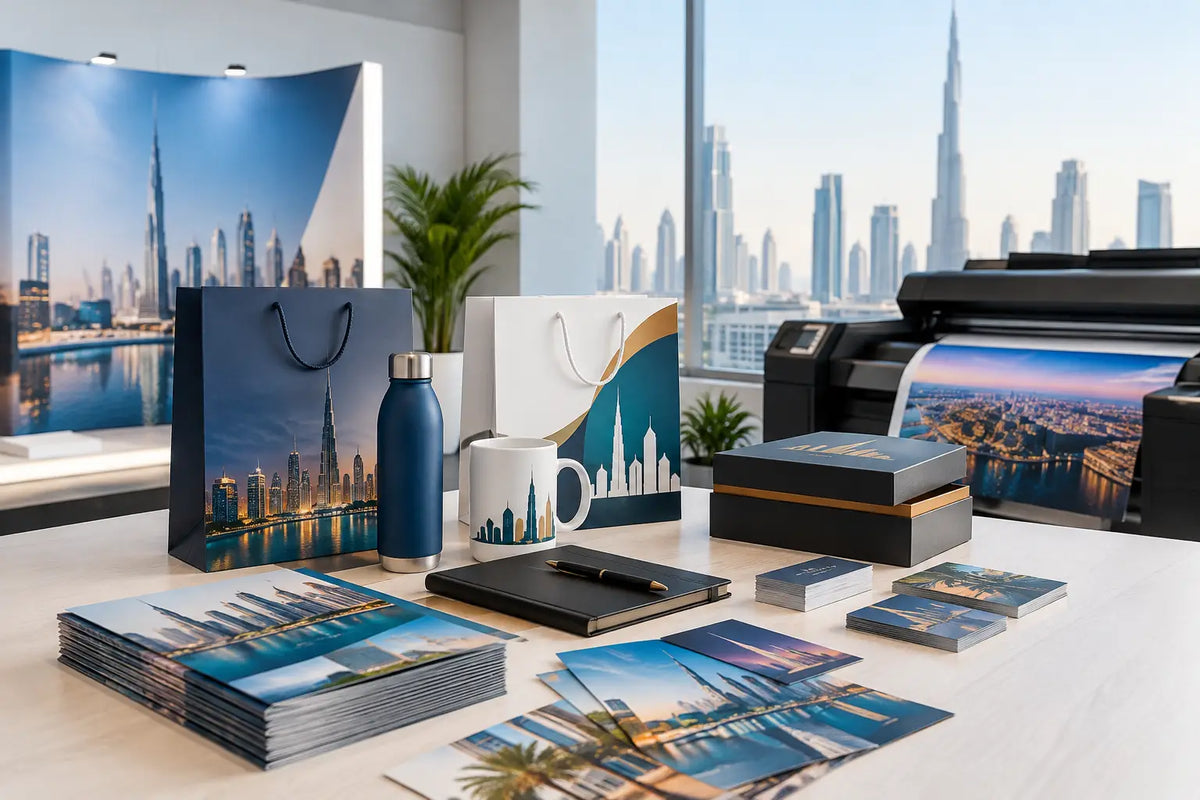
A reception counter, a retail shelf, and an exhibition stand may serve different purposes, but they all answer the same question in seconds: does this business look ready to be trusted? That is why Dubai printing trends are less about novelty for its own sake and more about producing branded materials that work harder - attracting attention, supporting sales conversations, and keeping every customer touchpoint consistent.
For procurement teams and marketing departments, the practical shift is clear. Print is no longer ordered as a separate set of items at the last minute. It is planned as part of the customer experience, from packaging and labels to office graphics, uniforms, event displays, and corporate gifts. The businesses getting the best results are choosing materials and formats around the job each item needs to do.
Dubai Printing Trends Shaping Business Materials
Premium finishes with a clear purpose
Premium finishes remain in demand, particularly for packaging, business cards, presentation folders, invitation sets, and executive gifts. Soft-touch lamination, spot UV details, foil accents, textured stocks, and raised effects can add perceived value when they support the brand position.
The trade-off is that a finish should not compete with the information. A luxury real estate brochure may benefit from a restrained foil logo and heavyweight cover stock. A restaurant menu or high-volume retail flyer may need a more durable, cost-conscious finish that can be reproduced consistently across multiple locations. The right choice depends on handling, quantity, lighting, and how long the item is expected to remain in use.
Premium does not always mean more effects. Often, it means cleaner color control, sharp typography, accurate brand colors, and materials that feel appropriate for the audience.
Packaging designed for the unboxing moment
Packaging has become a more visible brand asset for retailers, food businesses, beauty brands, corporate gifting programs, and product launches. Customers notice the outer box, sleeve, bag, label, tissue paper, insert card, and seal before they see the product itself.
Businesses are moving toward packaging systems rather than one-off boxes. A core structure can be used across a product range, while branded sleeves, stickers, or labels distinguish individual products and promotions. This approach can improve consistency while giving teams flexibility for seasonal campaigns, limited editions, or new SKUs.
Material selection matters here. Rigid boxes create a strong premium impression but require more storage and a higher investment. Folding cartons are practical for many retail products and can be produced in a wide range of sizes. Paper bags, custom tissue, and printed labels may be enough for a campaign where speed and presentation matter more than elaborate construction. Start with the product dimensions, weight, delivery method, and customer handling experience before deciding on the format.
Shorter, more targeted print runs
Marketing teams increasingly need smaller batches for focused campaigns, events, product tests, and location-specific promotions. Instead of ordering one design for every audience, businesses can adjust messaging for a trade event, a sales meeting, a retail activation, or a corporate gifting initiative.
This does not mean every project should be a short run. High-volume items such as standard labels, menus, forms, and regularly used packaging can be more efficient when planned in larger quantities. The practical approach is to separate evergreen materials from campaign-led materials. Keep stable, frequently used pieces in a well-managed supply plan, and use shorter runs where dates, offers, audience segments, or event details are likely to change.
Display systems built for reuse
Events in Dubai demand polished visual execution, but they also move quickly. Portable roll-up banners, modular backdrops, fabric displays, counter units, directional signs, and branded table covers remain valuable because they can be transported, installed, and reused with relative ease.
The current preference is for display systems that reduce setup pressure without looking temporary. For an exhibition booth, the question is not simply which banner is largest. It is whether the display can be read from a distance, whether the key message is visible in photos, whether the structure fits the venue, and whether the team can assemble it efficiently.
Reusable hardware with replaceable graphic panels is especially useful for companies that attend several events each year. It lets the business refresh campaign messages without replacing every physical component. For a single short-term activation, a simpler display may be the better commercial decision.
Brand Consistency Is Becoming an Operational Priority
One of the most meaningful shifts is happening behind the scenes. Businesses are connecting print decisions across departments instead of treating each order as an isolated request. The same logo version, approved colors, font rules, and messaging need to appear on staff uniforms, vehicle graphics, sales kits, labels, office signs, giveaways, and exhibition materials.
Inconsistent branding creates avoidable rework. A logo that looks acceptable on a digital presentation may not reproduce well on fabric embroidery, a small sticker, or a large-format wall graphic. Files need to be prepared with the final application in mind, including scale, color method, finishing requirements, and viewing distance.
A practical brand toolkit helps speed up ordering. It should include approved logo files, color references, artwork templates for recurring items, and clear guidance on what can be changed locally. This is particularly useful for multi-branch businesses, franchises, restaurant groups, and companies with active sales teams.
Sustainable Choices Need to Be Specific
Sustainability is influencing purchasing decisions, but buyers are asking more useful questions than simply whether something is eco-friendly. They want to know whether a material is recyclable in the intended disposal stream, whether it is durable enough to be reused, whether excess packaging can be removed, and whether the order quantity is sensible.
Paper-based packaging, recyclable boards, reusable display frames, and durable branded merchandise can all support more responsible sourcing when selected for the right use. However, there are trade-offs. A material that is easy to recycle may not offer the moisture resistance required for a food-related application. A reusable display is a stronger option only when it will genuinely be used multiple times.
The most practical strategy is to reduce waste through better specification. Choose the correct size, avoid unnecessary layers, consolidate related branded items where possible, and select materials based on real performance requirements rather than broad claims.
Personalization Is Expanding Beyond Names
Variable personalization is gaining relevance in corporate gifting, employee onboarding, loyalty programs, direct outreach, and event registration packs. A name on a notebook, bottle, badge, or gift box can make an item more memorable, but the broader opportunity is relevance.
A welcome kit for a new employee can include department-specific materials. An event pack can carry a personalized badge and a QR-based call to action. A sales campaign can tailor printed inserts by industry or client type. These details make print feel less like a generic giveaway and more like part of a considered business interaction.
Personalization needs reliable data and clear approval steps. Spelling errors, duplicate records, and late changes can affect delivery schedules, so it is best to confirm data formatting before production begins. For larger programs, a sample approval can prevent repeat issues across the full order.
How to Plan a Print Order Around These Trends
Start with the business outcome, not the product name. If the goal is stronger event visibility, prioritize viewing distance, setup time, and portability. If the goal is a better retail experience, focus on packaging structure, shelf impact, and label durability. If the goal is consistent office branding, consider materials that coordinate across signs, wall graphics, stationery, and staff apparel.
Next, confirm the practical specifications early: final quantity, finished size, material, print colors, required finish, artwork readiness, and delivery date. These details determine the appropriate production route and help avoid last-minute compromises. It is also useful to order samples or review material options when texture, color accuracy, or durability will influence the decision.
For companies managing several categories at once, working with one supplier can simplify coordination. Printava supports custom business materials across packaging, signage, labels, exhibition products, uniforms, corporate gifts, and office branding, helping teams align specifications and delivery requirements across a campaign.
The strongest print choices are rarely the most elaborate. They are the ones that suit the setting, reflect the brand accurately, and arrive ready to perform. When your next campaign, opening, event, or product launch is being planned, build print into the brief from the beginning and request specifications that match the real job the material needs to do.