
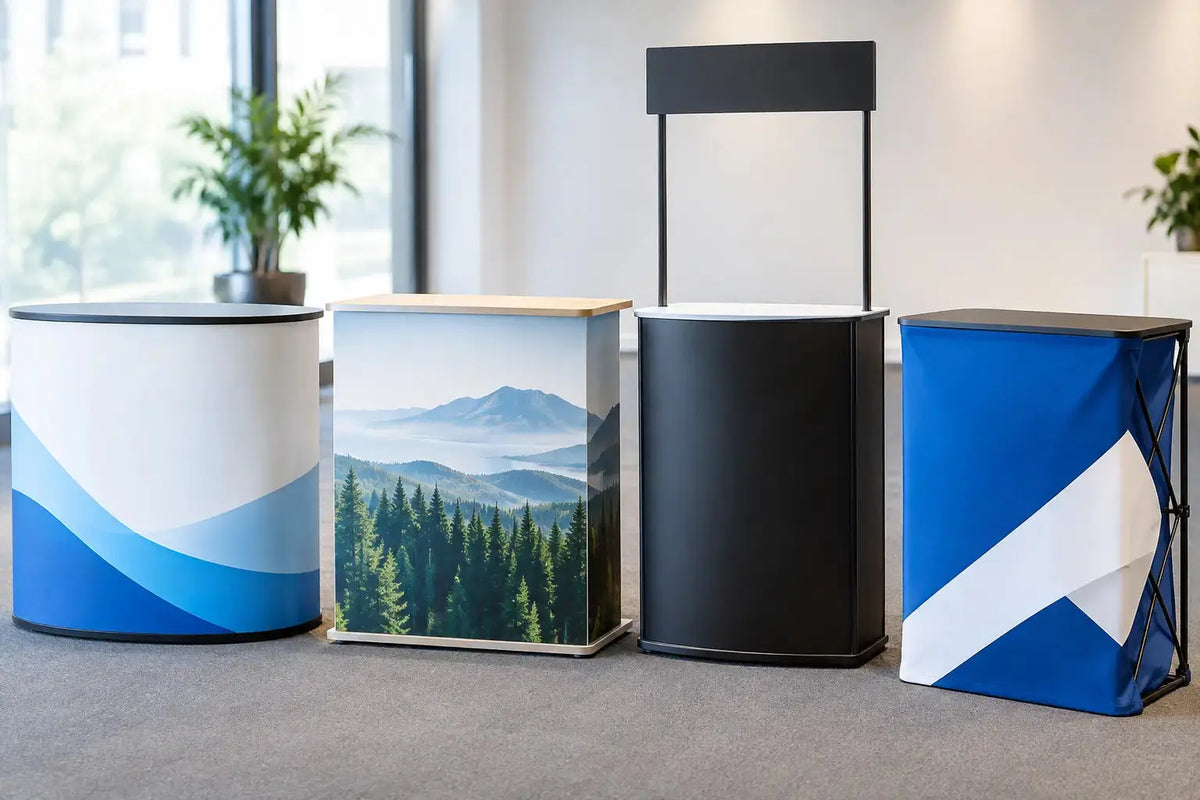
A counter is often the first surface visitors approach at a trade show. It holds brochures, supports a product demonstration, gives staff a defined place to start conversations, and carries your brand at eye level. Choosing between portable exhibition counter options is therefore not only a question of appearance. It affects setup time, transport requirements, storage, visitor flow, and how professionally your booth operates during a busy event.
For businesses exhibiting at conferences, retail activations, product launches, and corporate events, the best choice depends on the role the counter needs to play. A compact sampling station has different requirements from a reception point handling visitor registrations. The right display should be easy for your team to manage while giving the printed branding a clean, consistent finish.
Portable exhibition counter options by use case
Most portable counters fall into a few practical categories. The differences matter because the frame, countertop, graphic format, and carrying solution determine whether the unit is suited to frequent travel or a longer installation.
Pop-up counters for fast event setup
Pop-up counters use a collapsible frame that opens into shape, usually with a rigid countertop and a wraparound printed graphic. They are a reliable choice for standard exhibition booths because they create a defined branded point without requiring tools or complicated assembly.
These counters work well for brochure distribution, lead collection, visitor greetings, and product displays with lighter items. Their main advantage is speed: the frame folds down for transport and expands when the team arrives on site. A fitted graphic gives the counter a polished appearance from the front and sides.
The trade-off is storage capacity. Many pop-up counters offer limited space underneath, so they are better as a presentation surface than as a place to keep substantial stock. If staff need to store bags, sample inventory, or personal items during the event, consider adding a separate storage unit or selecting a counter designed with shelves or internal access.
Fabric counters for a clean, modern finish
Fabric exhibition counters combine a lightweight frame with a fitted stretch-fabric graphic. The result is smooth, contemporary, and especially effective for brands using large areas of color, subtle gradients, or photographic artwork.
A fabric option is often a good fit for businesses attending multiple events with the same campaign message. The printed cover can be removed, folded, and packed efficiently, while the frame is designed for repeat assembly. Replacement graphics can also be practical when the structure will remain in use but the promotion, product range, or event message changes.
Before choosing fabric, consider the countertop and intended use. A counter used for laptops, payment devices, heavy brochures, or demonstrations needs a stable top surface and suitable internal support. Fabric displays look refined, but the frame specification should match the weight and activity expected at the booth.
Hard-case counters for travel-focused teams
Some transport cases convert into branded counters once you reach the venue. These are particularly useful when exhibition materials must be moved regularly between locations, as the case protects the display components in transit and then becomes a functional part of the setup.
For sales teams and event organizers carrying backdrop systems, brochures, giveaways, and display accessories, this format can reduce the number of separate items to manage. Once dressed with a printed graphic and countertop, the case reads as a purpose-built reception or information counter rather than luggage.
This option is a strong operational choice, although its shape and size may be more standardized than a custom counter. It is best for teams prioritizing mobility and protection over a highly tailored configuration.
Modular counters for larger branded spaces
Modular counter systems are designed for brands that need more than one small point of contact. They can be arranged as reception desks, product demonstration stations, L-shaped service areas, or connected display units. Depending on the system, panels and graphics can be changed to support different booth sizes or campaigns.
The flexibility is valuable for companies that exhibit at several event formats throughout the year. A larger booth may require a main welcome desk and two product counters, while a smaller activation may use only one section. Modular systems can support this variation without requiring an entirely new display package each time.
However, modular counters require more planning. Confirm the available booth footprint, access routes, assembly support, and graphic layout before ordering. They are portable, but they are not always the fastest choice for a single-staffed setup or a very small event space.
How to choose the right portable exhibition counter
Start with what staff will actually do at the counter. A counter used to greet visitors and scan badges needs clear front branding, room for a tablet or laptop, and enough standing space behind it. A product sampling counter may need a wipeable top, concealed storage, and a layout that keeps the demonstration visible without creating congestion.
Next, assess the venue and travel plan. For frequent exhibitions, compact packed size, manageable weight, and a protective carry case are priorities. For a one-day event in Dubai where materials are delivered directly to the venue, a larger system may be practical if it gives the brand a stronger presence. The best decision is rarely about the largest counter available. It is about selecting a format your team can transport, assemble, and use confidently.
Counter height and width also shape visitor interaction. A standard standing-height counter suits quick conversations and lead capture. Wider counters create more working area but can become visually heavy in a small booth. If there will be several staff members, make sure the rear working area is not too narrow for movement, bags, and equipment.
Match materials to the event environment
The countertop is a working surface, not only a finishing detail. Choose a durable surface appropriate for brochures, laptops, packaged samples, or light product displays. A darker top can be forgiving in high-traffic environments, while a white or branded top may better suit a clean retail-style presentation. The choice should support the visual identity without making daily use difficult.
For the graphic, prioritize sharp print quality, readable messaging, and brand colors that remain consistent with your backdrop, roll-up banners, table covers, and promotional materials. Avoid placing too much copy on the front panel. From several feet away, visitors should recognize the company name, the core offer, and any clear call to action.
If the counter will be used outdoors or in a high-contact activation, discuss the intended environment before production. A suitable material and finishing approach will help the display remain presentable across the full campaign.
Plan the branding before production
A portable counter has limited graphic space, which makes design discipline essential. The front panel should do the primary branding work. Use the logo, a concise message, and high-contrast visual elements that remain recognizable from the aisle. Side panels can support secondary messaging, but they should not compete with the main brand mark.
Think about the counter as part of a complete exhibition view. If your backdrop promotes a specific product or campaign, repeat one key visual element or message on the counter rather than introducing a separate design direction. This creates a stronger visual connection across the booth and helps visitors understand the offer quickly.
Artwork should also account for frame edges, panel joins, and any areas hidden by the countertop. A supplier should review the production template and confirm the final artwork placement before printing. This is particularly important for logos, QR codes, contact details, and text placed close to graphic edges.
Questions to ask before ordering
Before approving a portable counter, confirm the packed dimensions, approximate assembled size, counter load guidance, graphic type, included carry solution, and expected setup process. Ask whether replacement prints can be produced later and whether spare parts are available for repeat use. These details are useful for procurement teams comparing options beyond the initial appearance.
It is also worth sharing the event date, booth size, and the other displays being used. Printava can help businesses coordinate counters with exhibition backdrops, banners, branded giveaways, and printed collateral so the final setup looks planned rather than assembled from unrelated items.
A well-chosen counter gives your staff a practical base and gives visitors a clear place to engage. Request a quote with your event requirements, branding artwork, and preferred counter use, then select the option that will keep working for your team long after the first event ends.