
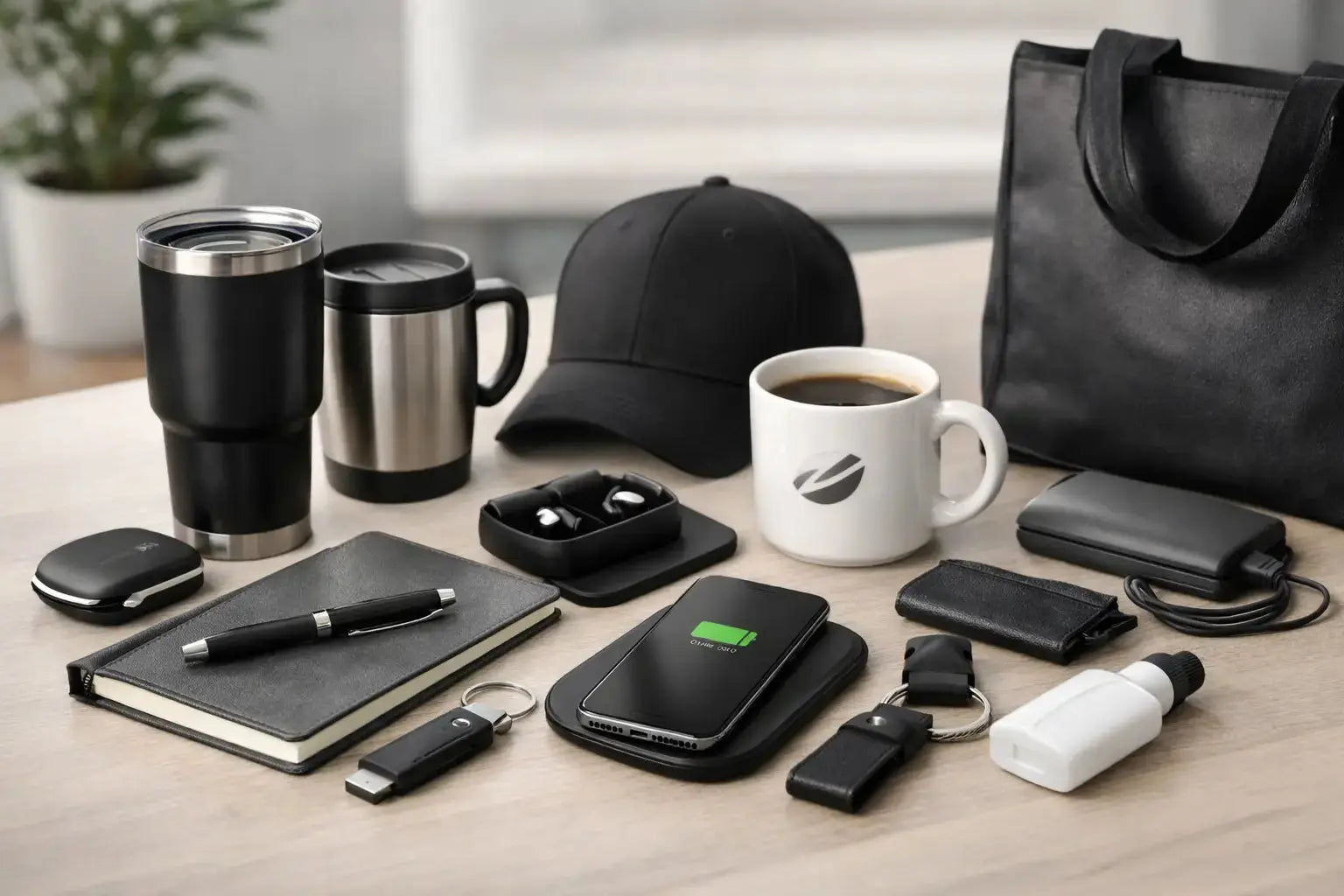
A rush event order, a sales kickoff, a new store opening, a trade show booth that needs more foot traffic - this is where promotional products either do their job or become wasted budget. The difference usually comes down to one thing: fit. The right item fits the audience, the setting, the timeline, and the brand standard you need to maintain.
For businesses, promotional products are not just giveaways. They are branded tools that support visibility, recall, and day-to-day use. A well-selected product keeps your company in front of prospects long after a meeting ends, helps your team look consistent at events, and gives customers something practical they are willing to keep. That is why buying decisions should be based on purpose, not just price or trend.
Why promotional products still matter
Digital campaigns move fast, but physical branding still has a different kind of staying power. When someone receives a useful branded notebook, bottle, pen, tote bag, desk item, or tech accessory, your brand enters their workspace, car, or daily routine. That repeated exposure is difficult to replicate with a short-lived ad impression.
This matters even more for companies that meet clients face to face, exhibit at trade shows, run activations, onboard employees, or manage multi-location branding. Promotional products give your marketing a physical layer. They support sales teams, event staff, HR departments, and procurement teams that need practical branded materials delivered correctly and on time.
There is also a trust factor. A product that feels well made reflects positively on your business. A poorly chosen item can do the opposite. That is why material, print method, packaging, and presentation all deserve attention.
How to choose promotional products for business goals
The best starting point is not the catalog. It is the use case. If the item is meant for a trade show, portability and quick handout value matter. If it is for a corporate client gift, presentation and perceived quality matter more. If it is part of an employee welcome kit, consistency across multiple branded pieces becomes the priority.
For events and exhibitions
Fast-moving events need products that are easy to distribute, easy to carry, and useful enough to avoid being discarded within the hour. Pens, tote bags, notebooks, lanyards, badges, bottles, and compact desk accessories often work well because they combine utility with broad audience appeal.
But there is a trade-off. Widely used items are popular because they are practical, yet they can also feel generic if the branding is weak or the quality is average. In these cases, finishing details matter. Clean printing, accurate logo placement, durable materials, and coordinated packaging can lift a standard item into something more professional.
For client gifting
Client-facing promotional products require better curation. The goal is not simply to place a logo on an object. It is to send something useful, brand-appropriate, and aligned with the relationship. Premium notebooks, insulated drinkware, executive desk items, gift sets, branded tech accessories, and custom packaging often perform better here than low-cost volume pieces.
This is where customization can add value. Name personalization, branded sleeves, inserts, and coordinated gift boxes help the item feel considered rather than mass distributed. It depends on the audience, of course. A practical operations team may prefer utility over presentation, while a decision-maker receiving a year-end gift may notice presentation first.
For internal branding and onboarding
Promotional products are also useful inside the business. Employee welcome packs, branded uniforms, ID accessories, desk items, and office-use products help create consistency from day one. For growing companies, this is often one of the simplest ways to reinforce brand standards without overcomplicating the process.
When teams are distributed across departments or locations, consistency matters even more. The print quality, colors, materials, and application methods should match across items so the final result feels organized rather than pieced together.
What makes a product effective
Useful beats unusual most of the time. Buyers are often tempted by novelty because it seems memorable, but practical items usually deliver more repeat exposure. If someone uses the product weekly, your brand stays visible. If they look at it once and put it away, the return is limited.
Durability is the next filter. A bottle with weak finishing, a tote with poor stitching, or a notebook with low-grade paper can reduce the value of the brand impression. This is especially relevant for businesses that are presenting themselves as reliable, premium, or detail-oriented.
Print method matters as well. Screen printing, UV printing, engraving, embroidery, heat transfer, and labeling each suit different materials and product types. The right method affects appearance, longevity, and lead time. A logo that looks sharp on a flat surface may need adaptation for curved items, textured finishes, or fabric applications. Buyers who review proofs carefully usually avoid the most common production issues.
Common mistakes when ordering promotional products
A frequent mistake is choosing too quickly based on unit cost alone. Lower cost can make sense for large-scale campaigns, but if the item does not suit the audience or hold up in use, the spend is not efficient. It is better to match quantity and quality to the purpose.
Another issue is leaving decisions too late. Product selection, branding setup, proof approval, and delivery coordination all affect timing. If an event date is fixed, the safest approach is to work backward from the deadline and allow enough time for sampling, artwork checks, and any custom packaging requirements.
Brand inconsistency is another avoidable problem. Different departments sometimes order separately and end up with mismatched colors, varying logo sizes, or inconsistent messaging. Centralized coordination improves output and reduces rework.
Promotional products and brand consistency
Promotional products work best when they are part of a broader branded system. A trade show setup, for example, is stronger when giveaways, display materials, backdrops, brochures, uniforms, and packaging all feel connected. The same is true for retail campaigns, hospitality launches, and internal events.
This is where working with a supplier that understands more than just the item itself becomes useful. If the same partner can support branded printing, packaging, display materials, stickers, labels, event graphics, and corporate gifts, the process becomes more controlled. It is easier to maintain color consistency, coordinate timelines, and reduce communication gaps.
For many businesses in Dubai and across the UAE, this practical coordination matters as much as the product choice itself. Procurement teams and marketing managers usually need reliable execution, not extra complexity.
When custom-made products make sense
Ready-made branded items are often the fastest route and suit many campaigns well. They are practical for standard events, office needs, and repeat-use products where speed and proven formats are priorities.
Custom-made promotional products make more sense when the campaign has a strong concept, the audience is highly specific, or the item needs to reflect a premium brand position. Custom sizing, product design, inserts, sleeves, and packaging can improve impact, but they also require more planning and clearer approvals. The right choice depends on budget, timeline, and how much differentiation the campaign actually needs.
That is why a solution-oriented approach is valuable. Not every campaign needs full customization. Not every event should use the cheapest standard item either. The best outcome usually sits somewhere in the middle - practical, well branded, and aligned with the business objective.
How buyers can make ordering easier
The fastest quoting and production process usually starts with clear information. Product type, quantity, branding requirement, logo file, event date, and delivery location all help suppliers recommend the right option quickly. If there are size constraints, packaging expectations, or brand guidelines, sharing them early saves time later.
It also helps to decide what matters most before requesting options. If speed is the top priority, shortlist ready-stock products with proven branding methods. If presentation matters most, ask about gift sets, packaging, and finishing. If the campaign is large-scale, focus on consistency, stock planning, and distribution requirements.
At Printava, this kind of planning is what turns a product request into a usable business solution rather than another rushed order.
Promotional products work when they are selected with the same care as any other brand asset. If you are ordering for an event, a client campaign, or an internal rollout, get specific about the goal first, then choose the item that can carry your brand well. Get a quote today and start with products people will actually use.