
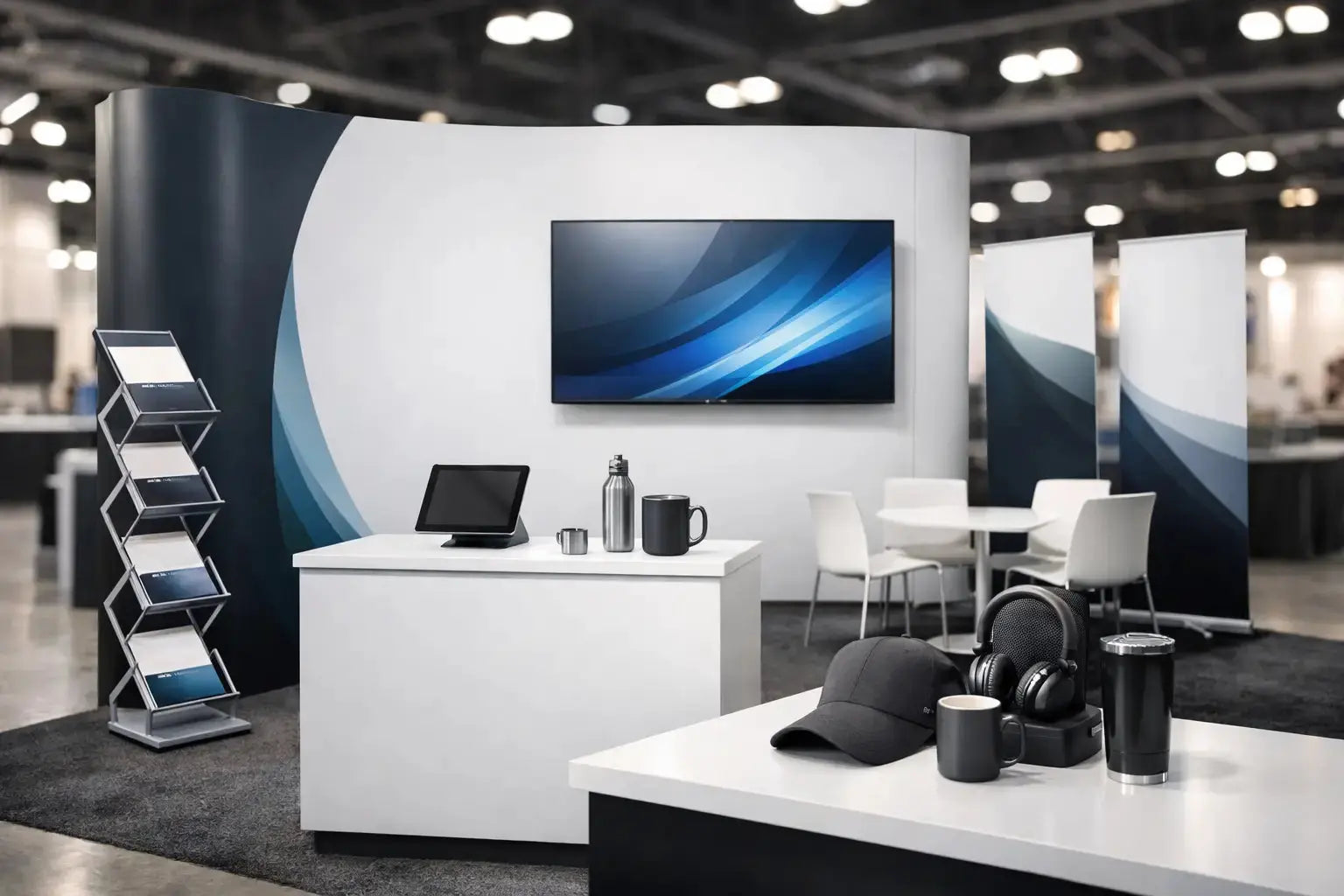
A busy exhibition hall gives you a few seconds to be understood. That is why a strong trade show booth branding example matters - not as design inspiration alone, but as a working model for how real visitors notice, remember, and approach your business.
For most exhibitors, the problem is not lack of effort. It is lack of clarity. Teams invest in backdrop printing, counters, brochures, giveaway items, and digital screens, yet the booth still feels fragmented. The message is there somewhere, but it is not landing fast enough. Good booth branding fixes that by aligning visuals, product focus, and visitor flow.
A practical trade show booth branding example
Imagine a 3m x 3m booth for a B2B packaging supplier exhibiting at a trade event. The company wants to attract retail brands, restaurant groups, and procurement managers. Its goal is not general awareness alone. It wants qualified conversations about custom packaging, labels, and branded takeaway materials.
The back wall carries one primary headline in large print: Custom Packaging That Looks Better and Delivers Faster. The company logo sits at the top left, visible but not oversized. Beneath the headline is a short supporting line that explains the offer in plain terms: boxes, sleeves, stickers, labels, and branded packaging for retail and food businesses.
On the right side of the wall, the booth features three large product visuals instead of ten small ones. One shows luxury retail packaging, one shows restaurant takeaway packaging, and one shows product labels applied on actual containers. Each visual is clean, high resolution, and tied to a buyer category. This matters because visitors often decide relevance before they read anything else.
At the front, a branded counter repeats the same color palette and logo treatment. The countertop is not crowded. It holds a small acrylic sign with a QR code for catalog access, a sample pack, and a lead form device. Staff wear matching branded uniforms in the same brand colors as the booth graphics. Behind the counter, one slim roll-up banner highlights turnaround categories such as custom boxes, printed labels, and event packaging solutions.
This booth works because every element supports one commercial message. It does not try to show the entire company catalog in one small space. It helps the right visitor identify the offer quickly and start a useful conversation.
Why this trade show booth branding example works
The first reason is message hierarchy. Visitors should understand what you do from a distance, then see proof up close. If the logo is the biggest thing on the stand but the service is unclear, the booth is underperforming. Brand recognition matters, but service recognition closes the gap between visibility and engagement.
The second reason is consistency. The booth backdrop, counter wrap, printed handouts, business cards, sample packaging, and staff presentation all speak the same visual language. Consistent branding builds trust because it signals control and professionalism. In trade shows, buyers often make fast judgments about whether a supplier looks organized enough to deliver.
The third reason is selective content. Many exhibitors overcrowd the booth with text, product lists, and too many competing images. That usually reduces impact. A better approach is to prioritize one core value proposition, two or three product families, and one clear next step.
There is also a practical reason this setup performs well. It respects viewing distance. A booth graphic is not a brochure on a wall. Text that reads well on a laptop screen may disappear in a crowded event hall. Strong booth branding uses fewer words, larger type, and visuals that make sense even when people are walking past.
What businesses should include in their own booth branding
If you are planning your next exhibition stand, start with the basics that shape buying behavior. Your logo should be visible, but your offering should be even clearer. A visitor should know within seconds whether you provide signage, packaging, uniforms, promotional gifts, labels, or another business service.
Your booth should also answer the buyer's practical questions quickly. What do you make? Who is it for? Can you customize it? Is it premium, portable, fast to install, or suited for retail, hospitality, events, or corporate use? The answers do not need to appear as long paragraphs. They need to show up through smart copy, product visuals, and physical samples.
Materials matter too. A premium-looking design printed on suitable exhibition materials creates a very different impression than artwork that is visually strong but poorly adapted to the display format. Tension fabric backdrops, rigid display panels, branded counters, tabletop displays, and roll-up banners all have different use cases. The right combination depends on budget, transport requirements, venue rules, and how many events the setup needs to support.
Portability is another factor companies often underestimate. A large customized build can look impressive, but if your team attends multiple events and needs faster setup, modular display branding may be the better commercial choice. The best solution is not always the biggest one. It is the one your team can use consistently without unnecessary friction.
Common branding mistakes that weaken booth performance
One of the most common mistakes is designing for internal approval instead of visitor behavior. Teams add every service category because each department wants visibility. The result is a booth that says too much and lands too little. Buyers do not reward complexity. They respond to relevance.
Another issue is weak visual contrast. If your headline blends into the background, or if the typography is too small, people will not stop long enough to decode it. Exhibition branding needs to perform under bright venue lighting, across different sightlines, and in spaces full of visual competition.
A third mistake is inconsistency between printed materials and the booth itself. If the backdrop presents one message, the flyer promotes another, and the giveaway item has unrelated artwork, the visitor leaves with a blurred memory of your brand. Strong execution means every printed and display element supports the same sales objective.
There is also the problem of missing interaction points. A booth can look polished but still fail to convert if there is no simple path to continue the conversation. That might be a QR code, a sample request, a short form, a printed catalog, or a visible product demo. Branding gets attention. Structure helps capture interest.
How to build your booth branding around business goals
The right booth design starts before the artwork stage. First, decide what success means for the event. If your target is lead generation, the booth should guide people toward inquiry. If your target is product launch visibility, the branding should center on the new item or category. If your goal is distributor conversations, the messaging should reflect scale, consistency, and supply capability.
Next, match display choices to the event format. A small shell scheme booth needs a sharper editing process than a large custom space. In a compact area, one branded backdrop, one counter, and one carefully chosen display banner can outperform a crowded setup with too many messages. For larger booths, zoning becomes more important. You may need a brand wall, a demo zone, a meeting point, and supporting signage that keeps the experience organized.
Then focus on brand continuity across all touchpoints. This includes exhibition graphics, brochures, presentation folders, business cards, stickers, labels, packaging samples, uniforms, and handout items. When these pieces work together, the booth feels deliberate rather than assembled at the last minute.
For businesses exhibiting in Dubai and across the UAE, this matters even more because events are highly competitive and visually polished. Buyers expect print quality, clean finishing, and dependable presentation. A booth that looks prepared gives your team a stronger starting point before the first conversation begins.
Turning a good booth into a better sales tool
A strong booth does not need to be flashy. It needs to be easy to understand, visually consistent, and commercially focused. That is the real value behind any useful trade show booth branding example. It shows that effective branding is not about adding more elements. It is about choosing the right ones and making them work together.
If your next event matters, treat booth branding as part of your sales process, not a last-minute print task. Clear graphics, suitable materials, branded display products, and consistent execution can change how quickly people recognize your offer and how confidently they approach your team. If you are planning exhibition materials and want practical support on setup, print quality, and branded display options, Printava can help you move from concept to execution with less guesswork. The best booth is the one that makes your business easier to remember and easier to buy from.