
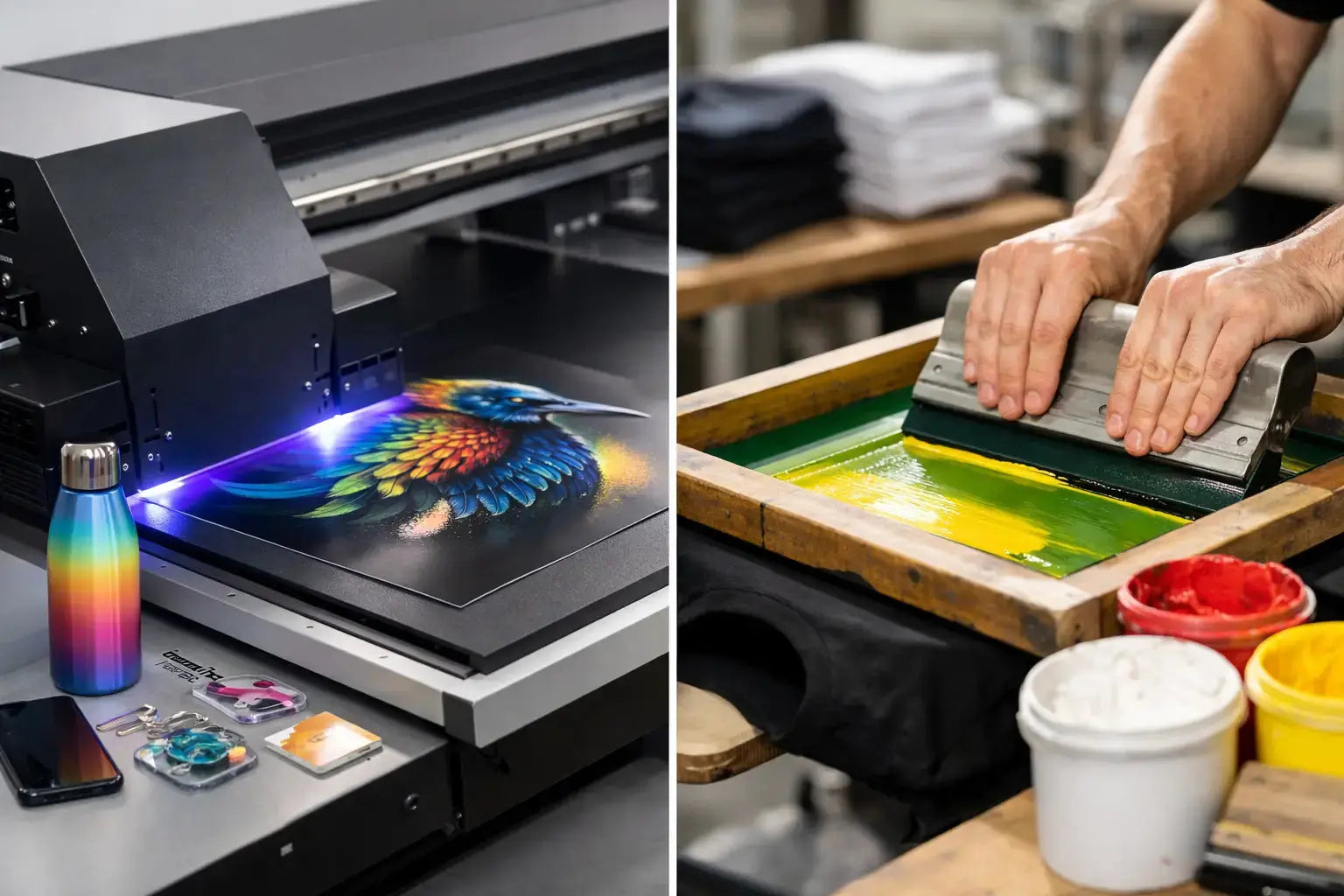
A rushed print decision usually shows up later - in missed brand consistency, material mismatch, or a finish that looked right on paper but not on the final product. When comparing uv printing vs screen printing, the better choice depends less on which method is "best" and more on what you are printing, how many units you need, and how the finished item will be used.
For business buyers, this choice affects more than appearance. It influences turnaround planning, setup efficiency, color expectations, substrate compatibility, and total production logic. If you are sourcing signage, labels, packaging, promotional items, or branded display materials, understanding where each method performs well can save time and reduce rework.
UV printing vs screen printing: the real difference
UV printing is a digital process that prints ink directly onto a surface and cures it instantly with ultraviolet light. Because the ink cures on contact, the result is sharp, durable, and well suited to a wide range of rigid and flexible materials. It is often used for acrylic, PVC, foam board, wood, glass, metal, packaging surfaces, stickers, labels, and custom promotional products.
Screen printing works differently. Ink is pushed through a mesh screen onto the material, with each color typically requiring its own screen setup. This method has been trusted for years for textiles, bulk promotional runs, signage, and designs where strong solid color coverage matters.
The key difference is production style. UV printing is more flexible and efficient for customized, short-run, or material-specific work. Screen printing becomes attractive when the artwork is stable, quantities are higher, and the setup cost can be spread across a larger order.
When UV printing makes more sense
If your order includes multiple designs, variable artwork, or a smaller quantity, UV printing is often the more practical route. There is less setup involved, which makes it easier to move quickly from file approval to production. For marketing teams managing campaign materials or procurement teams ordering mixed branded items, that flexibility matters.
UV printing also performs well when the material itself is part of the brand presentation. A printed acrylic sign in a reception area, a branded panel for an exhibition stand, or custom packaging with crisp detail benefits from the precision of digital UV output. Fine text, gradients, and detailed graphics tend to reproduce cleanly.
This method is also useful when you need direct printing onto non-porous or rigid substrates. Rather than applying a separate print and then mounting it, UV printing can often go straight onto the finished surface. That can simplify production for office branding, retail display elements, and event signage.
Another advantage is consistency across smaller batches. If your business needs 25 units now and a repeat order later, UV printing can make that easier to manage without rebuilding an entire screen setup for each variation.
When screen printing is the better fit
Screen printing remains a strong option for volume production, especially when the design is simple, bold, and repeated across many pieces. If you are printing a large run of the same artwork on shopping bags, uniforms, promotional apparel, or flat items with limited colors, screen printing can be very efficient.
It is also a reliable choice when ink deposit and solid color impact are priorities. Certain applications benefit from the heavier laydown of ink that screen printing can provide. Logos with strong blocks of color, especially on textiles or specific promotional surfaces, often translate well through this method.
Where screen printing earns its place is scale. Once the screens are prepared, repeat production can move efficiently for long runs. For businesses ordering high volumes of the same branded item for a campaign, launch, or internal rollout, that production model may align better with the project.
The trade-off is flexibility. Design changes, versioning, or multiple artwork variations add complexity because each change may require additional setup. That is why screen printing tends to work best when the design is locked and the quantity justifies the preparation.
Quality, detail, and finish
Businesses often ask which method looks better. The honest answer is that it depends on the design and substrate.
UV printing typically has the edge for fine detail, small text, photographic elements, and artwork with gradients or layered visual effects. If your brand assets include detailed logos, QR codes, product information, or high-resolution imagery, UV printing gives you more control over precision.
Screen printing excels in clean, bold graphics. It is especially effective for straightforward branding where visual strength matters more than photographic complexity. On the right material, a screen-printed logo can look crisp, intentional, and highly consistent across a large batch.
Finish is another factor. UV printing can support glossy, matte, and specialty effects depending on the application and substrate. Screen printing can also produce excellent visual impact, but the result is tied closely to ink choice, material compatibility, and the structure of the design.
Material compatibility matters more than most buyers expect
One of the biggest mistakes in print buying is choosing a print method before confirming the substrate. The material should guide the process, not the other way around.
For rigid boards, acrylic panels, PVC sheets, branded display pieces, and certain packaging components, UV printing is often the more natural option because it can print directly onto the surface. This reduces handling steps and can improve alignment for visual applications.
For garments, fabric items, and some bulk promotional products, screen printing is often preferred because it works well with repeat designs and can deliver strong color performance on suitable textile bases.
Labels and stickers can go either way depending on quantity, design complexity, and finish requirements. A short-run promotional label with detailed artwork may suit UV printing. A larger run with simple branding and repeat output may lean toward screen printing if the material and production setup are right.
Cost is not just about unit price
Buyers often compare printing methods by asking which one is cheaper. That question is too narrow to be useful.
Screen printing can offer strong value on larger runs because the setup cost is distributed over more units. If you are producing high volumes of identical items, the economics can work in your favor.
UV printing often makes more commercial sense for lower quantities, custom batches, and projects with multiple versions. You may avoid screen setup costs, reduce pre-production time, and gain flexibility if approvals change or departments need different branded variations.
The more useful question is this: what is the most efficient method for the quantity, material, and artwork you actually need? That is where real cost control happens.
Turnaround and project planning
For many businesses, speed matters almost as much as quality. Product launches, events, retail campaigns, and office updates all run on deadlines.
UV printing can support faster movement on short-run or customized orders because it requires less setup between designs. That makes it a practical option when timing is tight and the order includes mixed graphics or a limited quantity.
Screen printing can also be efficient, but it benefits from planning. If the artwork is approved early and the order is large enough to justify setup, it can be a dependable production method. The challenge comes when teams request last-minute artwork changes, quantity splits, or multiple versions after screens are prepared.
That is why the best print partner will ask the right questions at the start: what material is being used, how many units are required, how many colors are in the design, whether the artwork will vary, and where the final product will be displayed or used.
How to choose between UV printing vs screen printing
If your project involves rigid materials, custom graphics, shorter runs, or detailed artwork, UV printing is usually the stronger fit. If your project involves larger volumes, repeat designs, bold graphics, and suitable substrates like textiles or bulk promotional items, screen printing may be the better production choice.
For many business orders, the right answer is not tied to a preferred method. It comes from matching the print process to the product. A signage order may be ideal for UV printing, while branded uniforms for the same campaign may be better in screen print. Treating everything as one production category often leads to compromise where it is not needed.
At Printava, that practical approach matters because most business buyers are not ordering one item in isolation. They are coordinating events, sourcing branded materials across departments, or managing launches with multiple product types. The print method should support execution, not slow it down.
If you are deciding between uv printing vs screen printing, start with the product, the quantity, and the end use. Once those are clear, the better method usually becomes obvious. Get a quote today with your artwork, material specs, and required quantities, and make the choice based on what will perform best in the real job - not just what sounds familiar.