
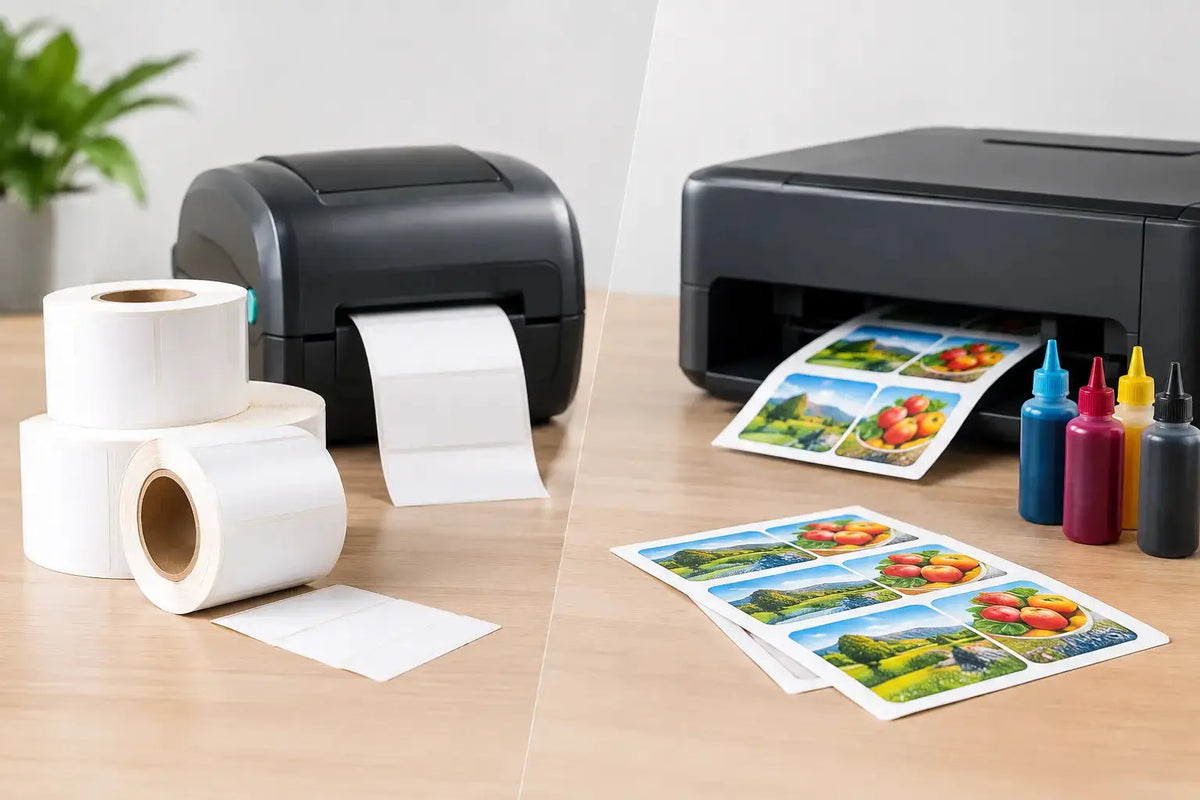
A warehouse label that scans cleanly, a food container label that stays readable, and a product label that presents brand colors accurately do not always require the same printing method. The decision between thermal labels versus inkjet labels affects print speed, color options, material selection, handling, and the consistency of every item leaving your business.
For procurement teams, retailers, restaurants, and growing brands, the right answer depends on what the label needs to do after it is applied. Is it carrying a barcode through a fast-moving supply chain? Is it selling a premium product from a shelf? Will it face heat, moisture, refrigeration, or frequent handling? Start with the label’s working environment, then select the print method and material that support it.
Thermal Labels Versus Inkjet Labels: The Core Difference
Thermal labels are produced with heat rather than liquid ink. In direct thermal printing, the printhead applies heat to a chemically treated label surface, creating a dark image. In thermal transfer printing, heat transfers ink from a ribbon onto the label material. Both methods are widely used for operational labeling because they produce sharp text, barcodes, serial numbers, and variable information efficiently.
Inkjet labels are printed using tiny droplets of liquid ink. They are often selected where full-color graphics, product imagery, color-coded designs, or detailed branding are central to the label’s purpose. The final result can look highly polished, particularly when the label stock, ink type, and protective finish are specified correctly.
Neither method is automatically better. Thermal printing prioritizes functional identification and repeatability. Inkjet printing prioritizes visual impact and color flexibility. A business shipping hundreds of parcels daily has different needs from a café launching a new line of retail-ready jars.
When Thermal Labels Make the Most Sense
Thermal labels are a practical choice for labels that carry changing information or need to be printed in volume. Shipping labels, carton labels, inventory tags, shelf labels, asset labels, receipts, and barcode stickers are common applications. Their clean, high-contrast output supports reliable scanning, which matters when an incorrect scan can delay picking, dispatch, or stock control.
Direct Thermal for Short-Term Information
Direct thermal labels do not require a ribbon, which simplifies day-to-day printing and reduces the consumables needed for many operations. They work well for courier labels, order tickets, temporary visitor labels, and short-life retail or food-service applications.
The trade-off is durability. Direct thermal print can gradually fade when exposed to sunlight, heat, friction, or certain chemicals. It is not the preferred option for labels that need to remain readable for long periods, especially on outdoor products, long-term assets, or items stored in demanding environments.
Thermal Transfer for Durable Identification
Thermal transfer labels use a ribbon and can be printed on a broader range of materials, including paper, polypropylene, polyester, and other synthetic stocks. The result is more resistant to smudging, abrasion, moisture, and environmental exposure when the ribbon and material are correctly matched.
This method is well suited to warehouse bins, industrial equipment, laboratory identification, inventory assets, durable product information, and labels that must survive transportation or storage. It is also a strong choice for businesses that need crisp black print, small text, consecutive numbering, QR codes, or barcode accuracy across recurring label runs.
Thermal printing is usually most efficient when your label design is primarily black and white and the information changes frequently. A branded logo can be included, but multi-color artwork is not its main advantage.
Where Inkjet Labels Add More Value
Inkjet labels are built for presentation. They allow brands to use full-color logos, photographs, illustrations, gradients, and visual design elements that help a product stand out. For packaging that is seen before it is handled, that added visual range can influence how professional and consistent a brand appears.
This makes inkjet labels a strong option for consumer-facing products such as food packaging, beverages, cosmetics, wellness products, promotional items, gift boxes, and retail merchandise. They can also suit marketing labels for campaigns, launches, seasonal offers, and event giveaways where the visual message is as important as the product details.
The label stock matters as much as the printer. A glossy paper label can create a premium display effect but may not be suitable for refrigeration or frequent moisture exposure. A waterproof synthetic label may be the better choice for chilled products, bottles, or items used in wet environments. Matte finishes can improve readability and create a more understated look, while gloss can make colors feel more vivid.
Inkjet labels require consideration of drying time, ink compatibility, and surface protection. Depending on the application, a laminate or protective coating may be appropriate to improve resistance to handling, water, oils, or scuffing. The right specification prevents a visually strong label from becoming impractical once it reaches the shelf, stockroom, or customer.
Compare the Decision Factors Before You Order
The fastest way to choose is to separate operational requirements from branding requirements. If a label must scan reliably, be printed with changing data, and move quickly through fulfillment, thermal printing is usually the more direct route. If the label is a key packaging element and must reproduce a full-color brand identity, inkjet printing is often the better fit.
Consider these questions before approving production:
- How long must the label remain readable after application?
- Will it be exposed to heat, sunlight, moisture, oils, refrigeration, or abrasion?
- Does the design require full color, product photography, or color matching?
- Will each label contain variable information such as a barcode, batch number, or expiry date?
- What surface will receive the label: cardboard, glass, plastic, metal, paper, or a curved container?
- Is the label applied manually, during packing, or through an automated process?
Material and Adhesive Can Change the Outcome
A print method alone does not determine label performance. Material and adhesive selection are equally important. Paper labels are economical and suitable for many indoor packaging and retail applications. Synthetic labels such as polypropylene or polyester offer greater resistance to water and handling, making them better suited to demanding environments.
Adhesive should be matched to the surface and temperature range. A permanent adhesive is common for product packaging and logistics labels, while a removable adhesive may be needed for temporary promotions, rental equipment, or reusable containers. Labels applied to cold products may need an adhesive designed for refrigerated conditions. Likewise, textured cardboard, curved bottles, and smooth plastic containers can each require different adhesive behavior.
For UAE businesses managing distribution, events, hospitality, or retail packaging, this specification work is especially useful. Products may move between air-conditioned interiors, delivery vehicles, storage areas, and customer-facing displays. Selecting materials based on actual conditions helps maintain a clean, consistent presentation through the full process.
A Practical Recommendation by Use Case
For shipping, warehouse management, inventory control, and barcode-driven workflows, thermal labels are generally the most efficient choice. Direct thermal works for short-term labels, while thermal transfer supports longer-lasting identification and tougher conditions.
For branded packaging, product launches, retail displays, and promotional campaigns, inkjet labels are often the stronger option because they support color-rich design and a broader visual finish. Pair the print with the appropriate paper or synthetic stock, adhesive, and protective treatment for the product’s environment.
Some businesses need both. A branded full-color inkjet label can carry the customer-facing packaging design, while a thermal label adds a shipping barcode, batch code, or fulfillment instruction later in the process. This approach keeps packaging professional without compromising operational speed.
The most effective label program does not begin with a printer. It begins with the job the label must perform. Share the intended surface, label size, artwork, quantities, and handling conditions with your print supplier, then request a specification that supports both brand consistency and day-to-day execution. Printava can help businesses match labels to packaging, logistics, retail, and event requirements, so every order is ready to perform when it reaches the next stage.